
Oberammergau
15"
Swivel Neck
$24,750.
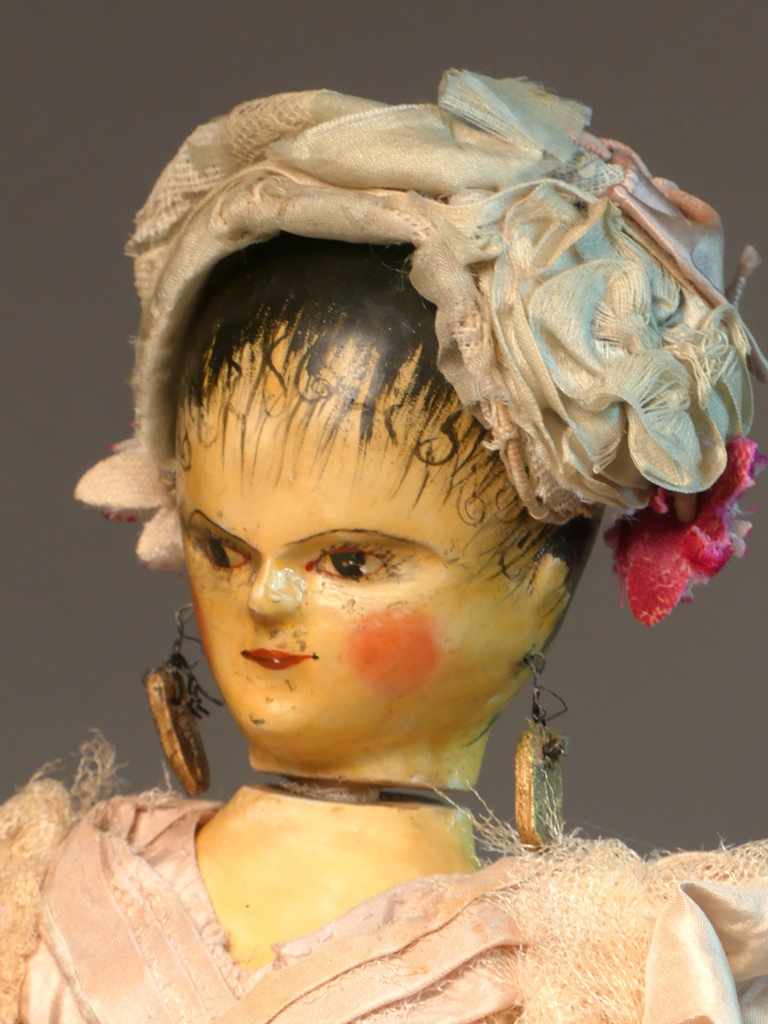
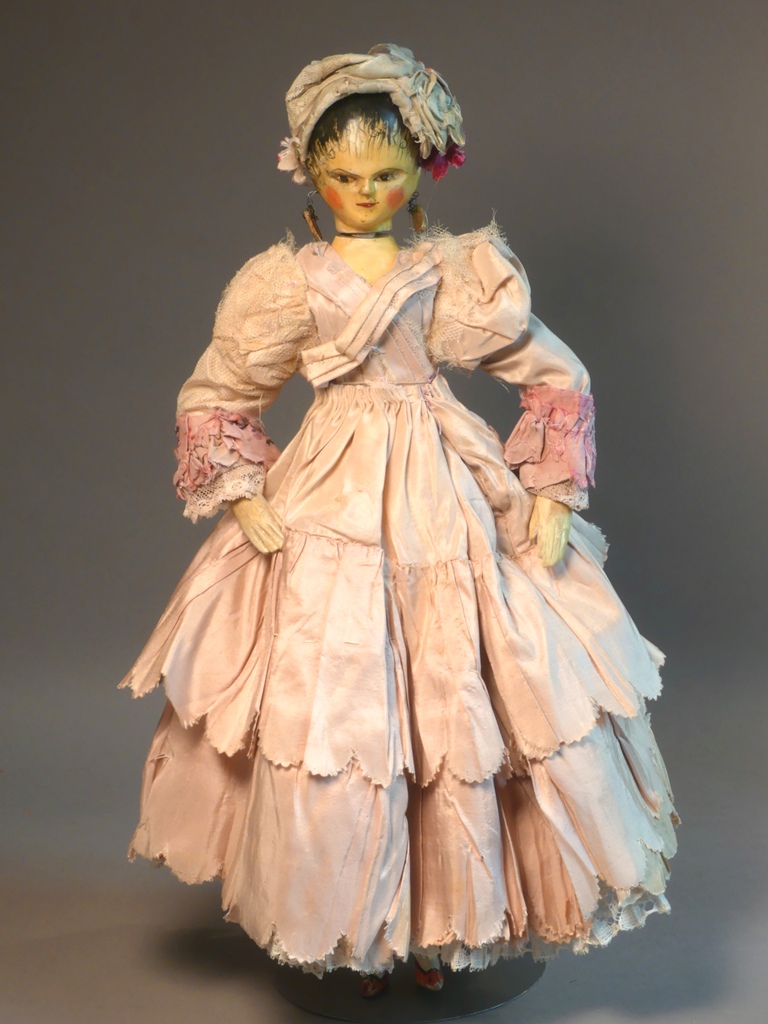
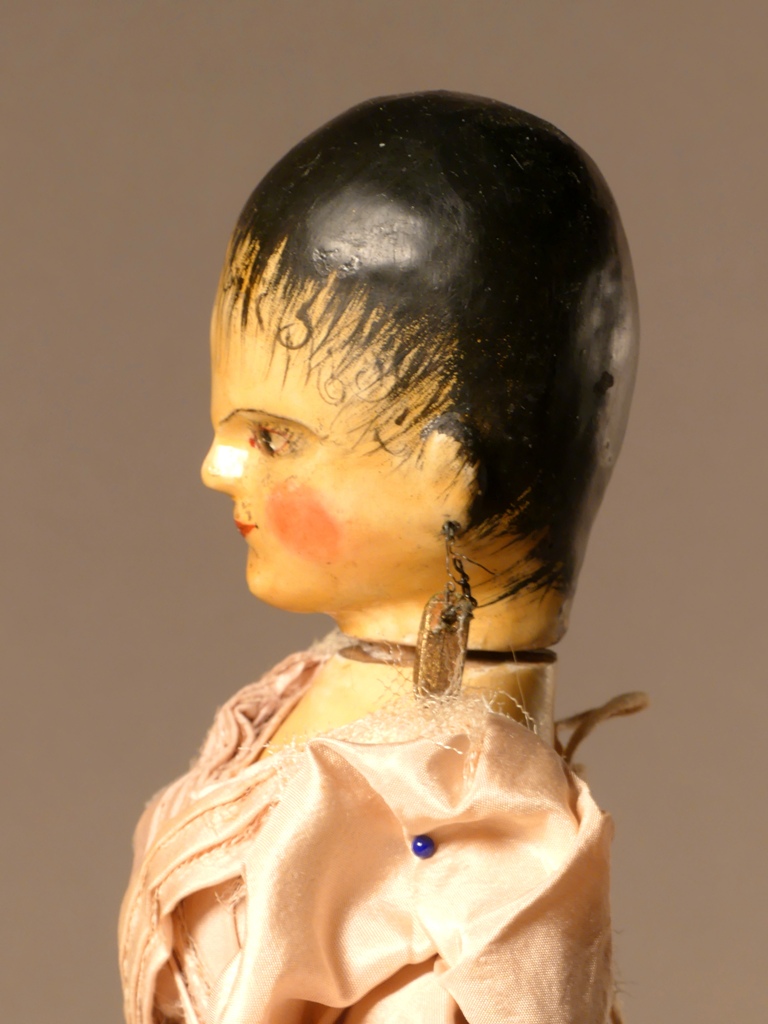
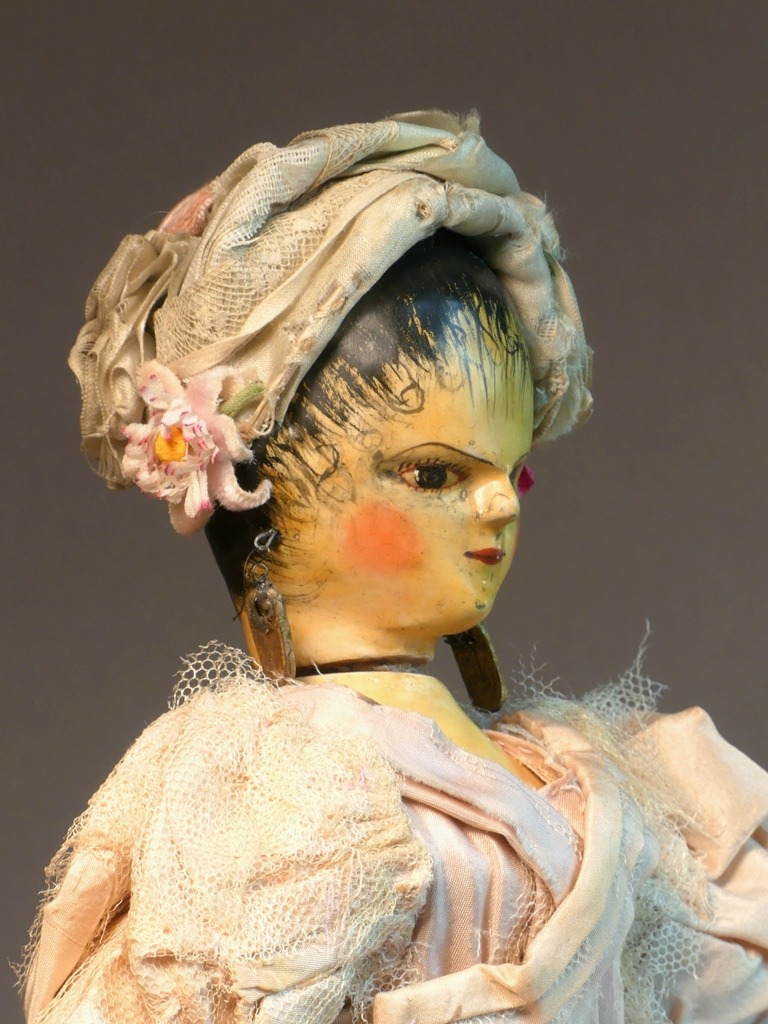
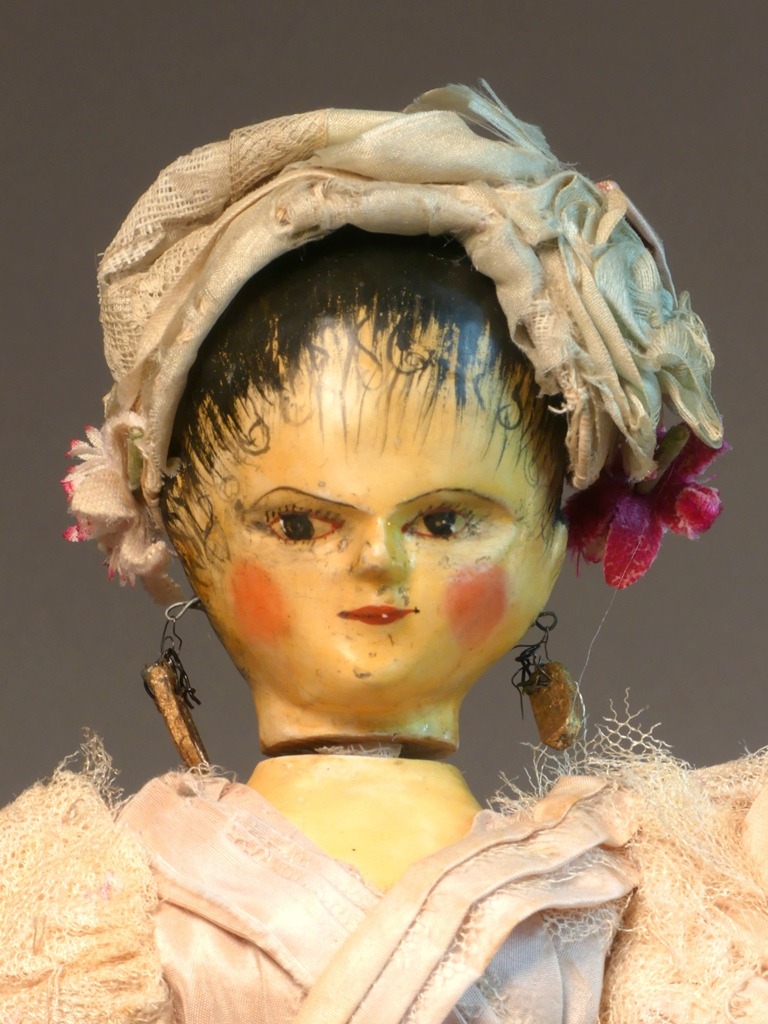
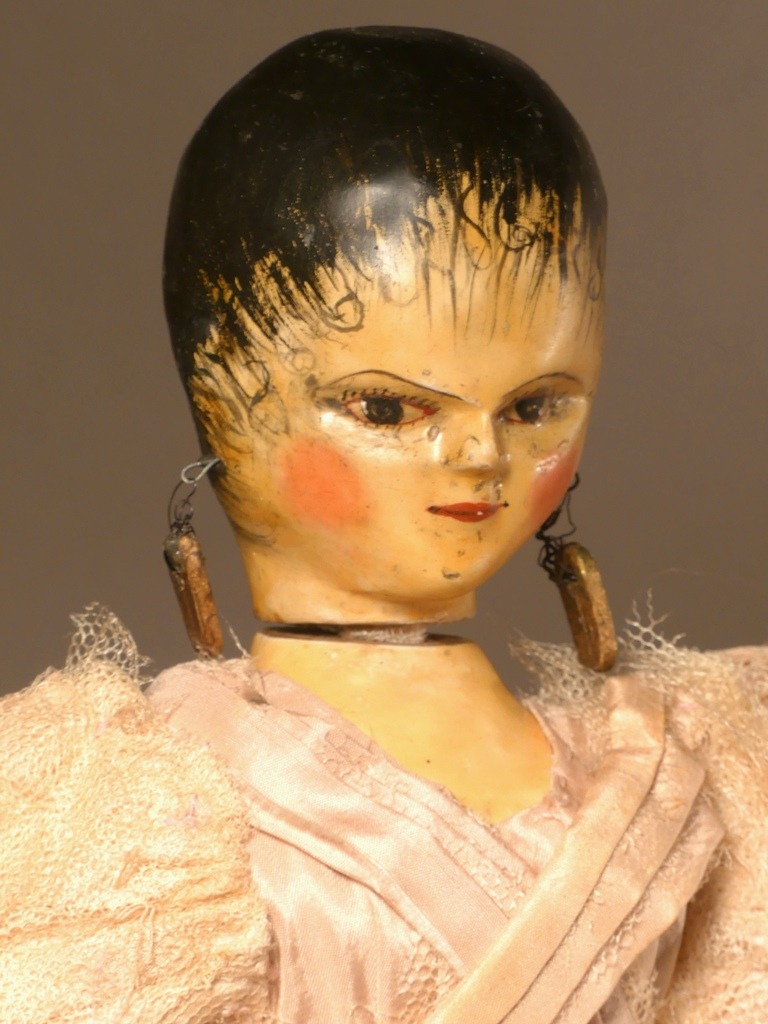
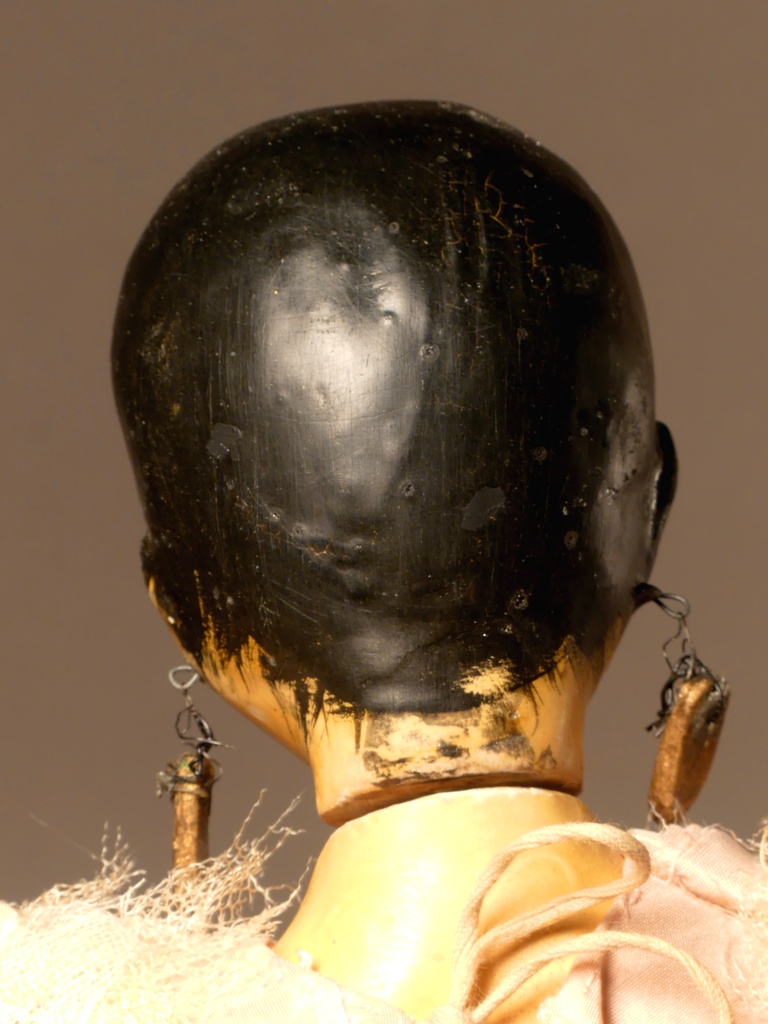
Such a strong personality is expressed by this very early wooden doll of the Oberammergau region of Germany, circa 1800. She is completely of carved wood, having little to no touch up to her original paint, with a strong brow line, pinched, serious features, rouged cheeks, exposed ears with wooden, dangling earrings and highly detailed, painted strands of hair encircling her hairline. Of great rarity is her swivel neck, although it has restricted mobility.
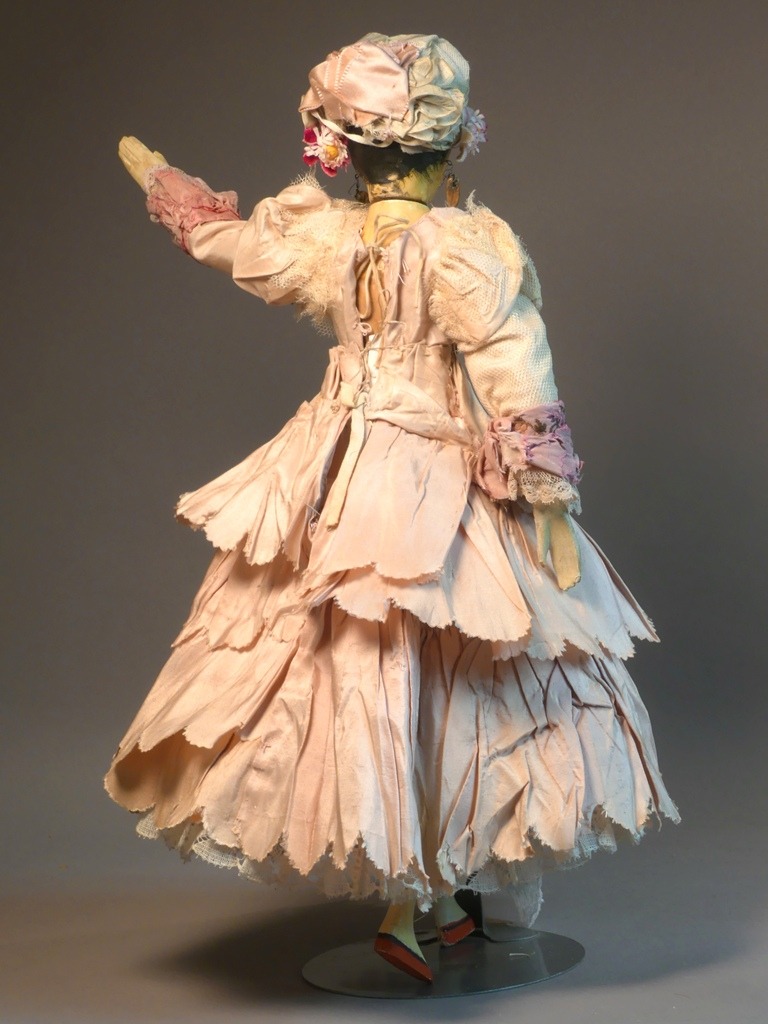
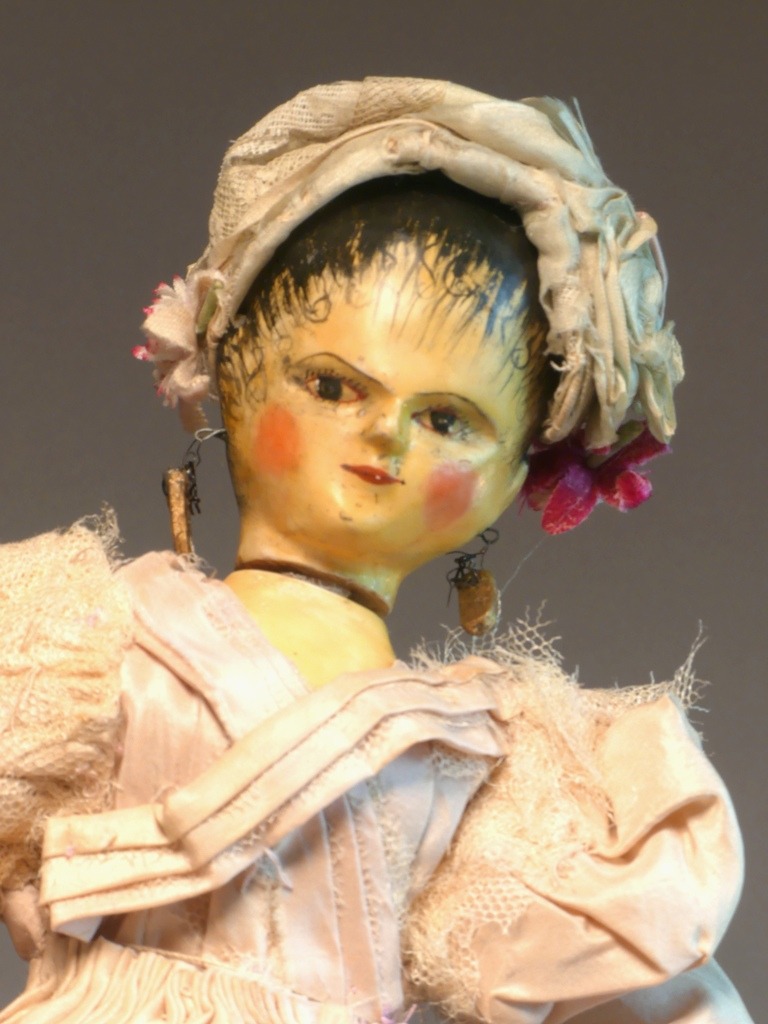
Her wood body is finely carved and fully jointed, with carved fingers on her elongated arms and hands, and carved long slippers at the end of her long, slender legs. It is difficult to say if her garment is original, but this very old, layered pink silk dress has the loosening stitches and constructional stiffness of a VERY old garment. Even the matching bonnet has the same imperfect attributes that we antique souls love!
s s s
16 1/2" Early Continental Wooden
$16,500.
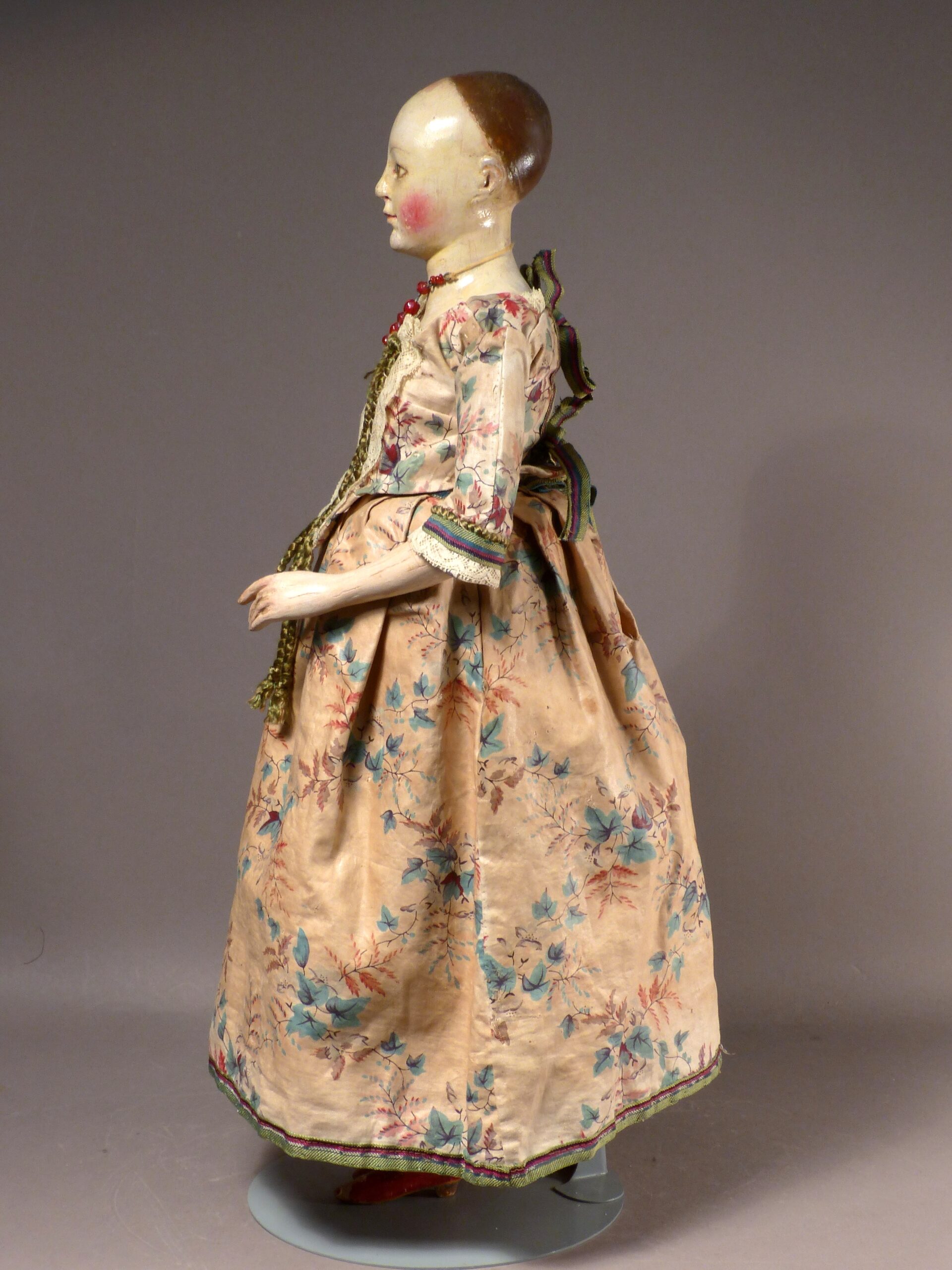
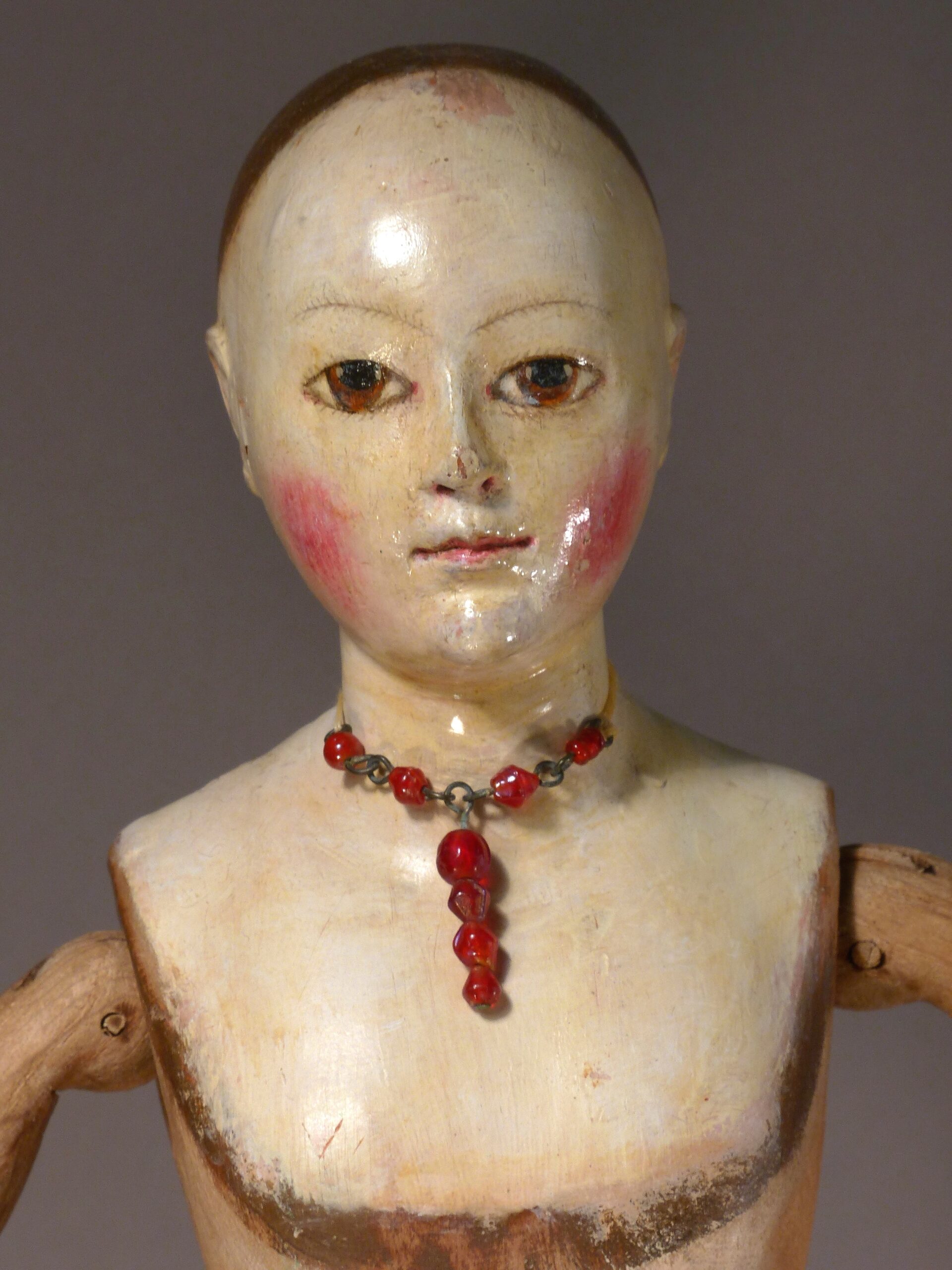
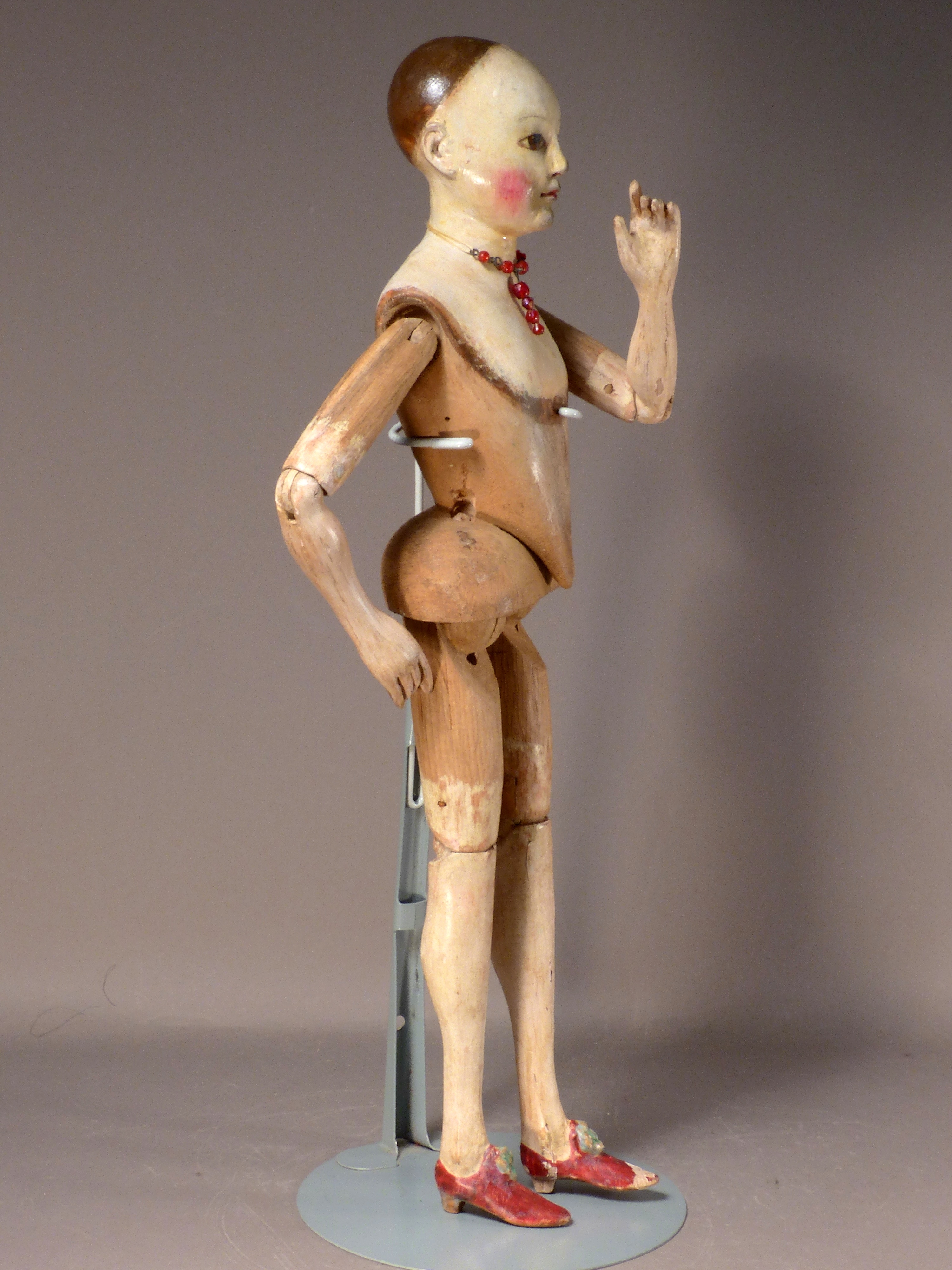
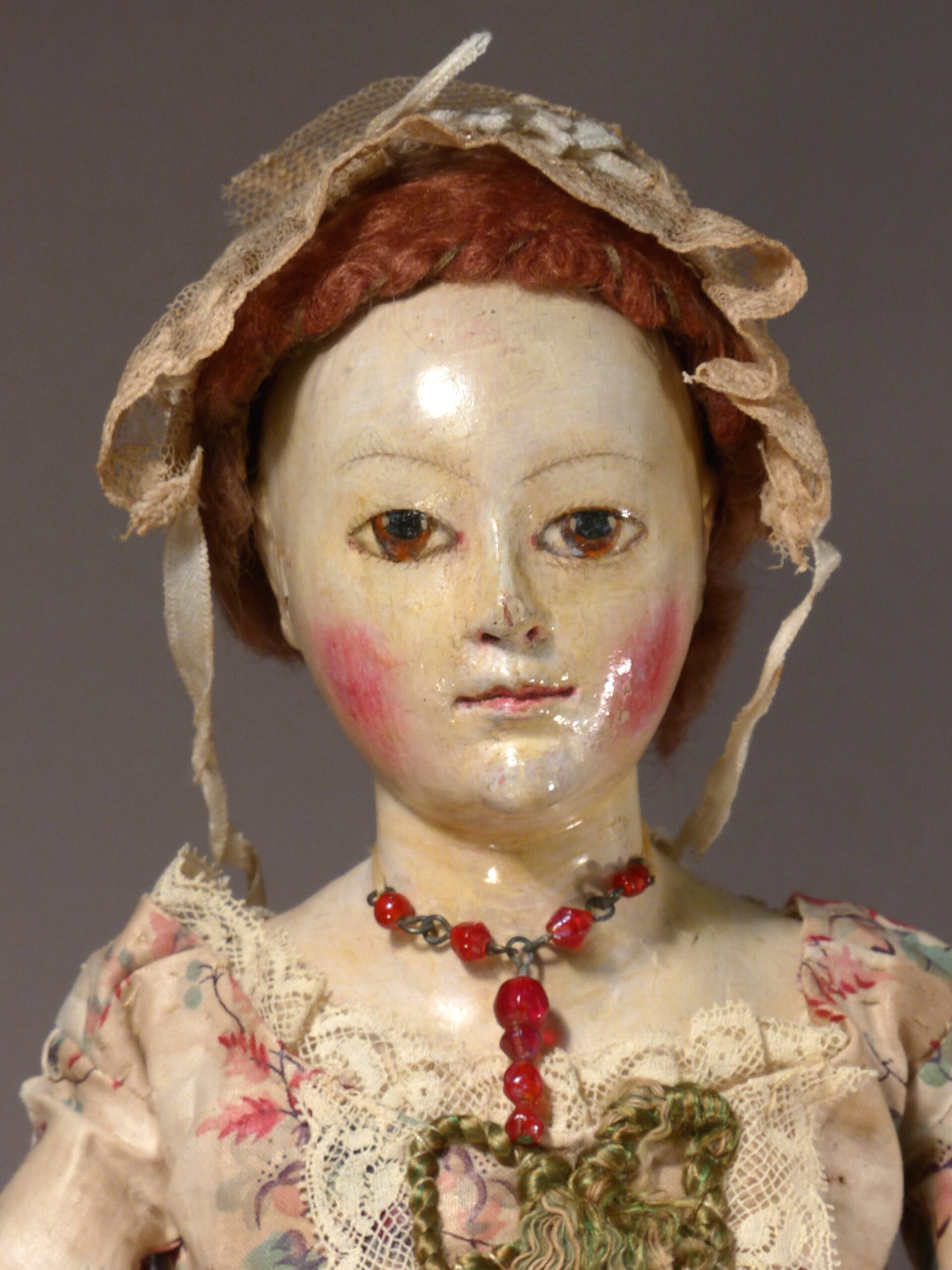
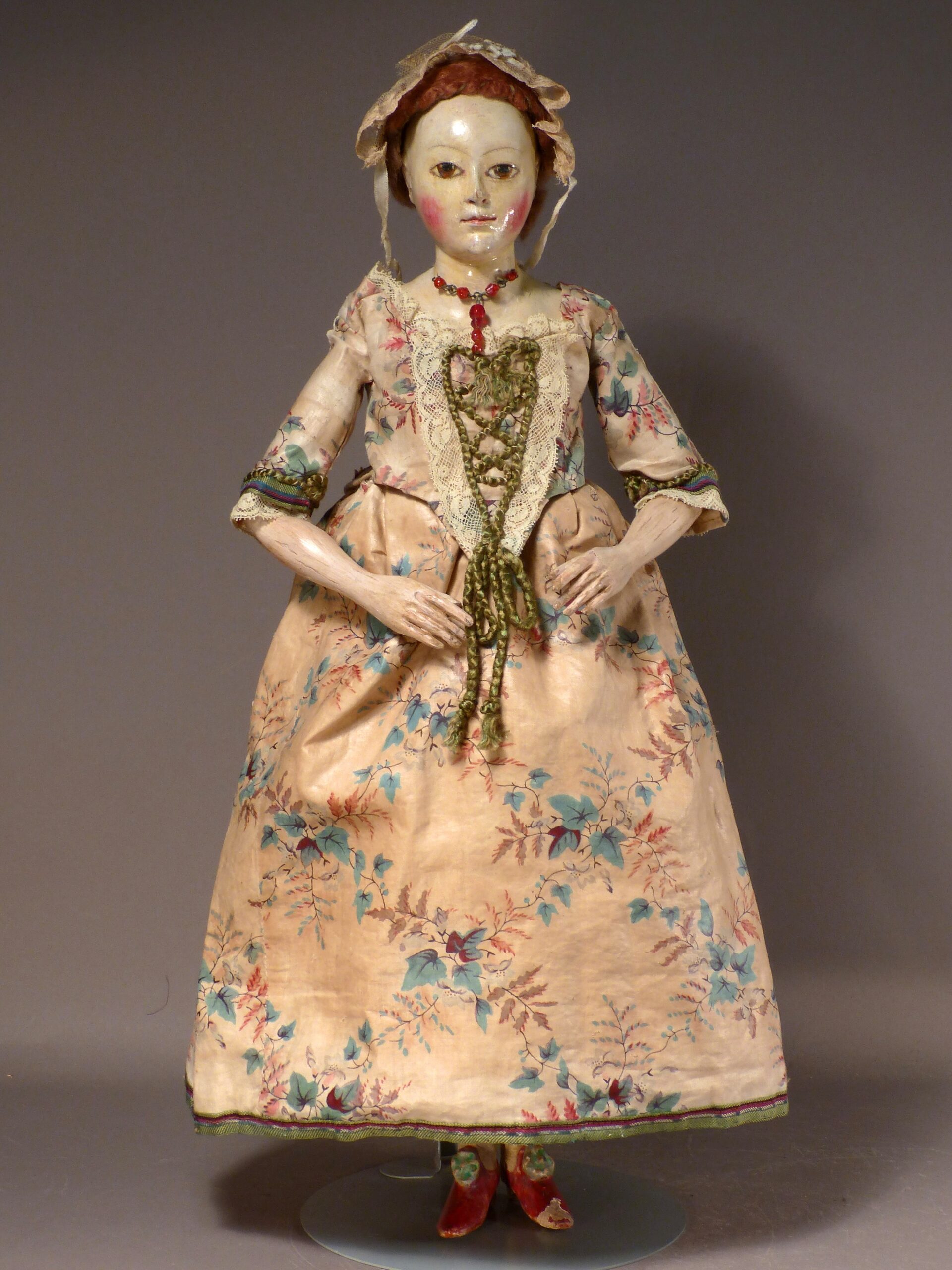
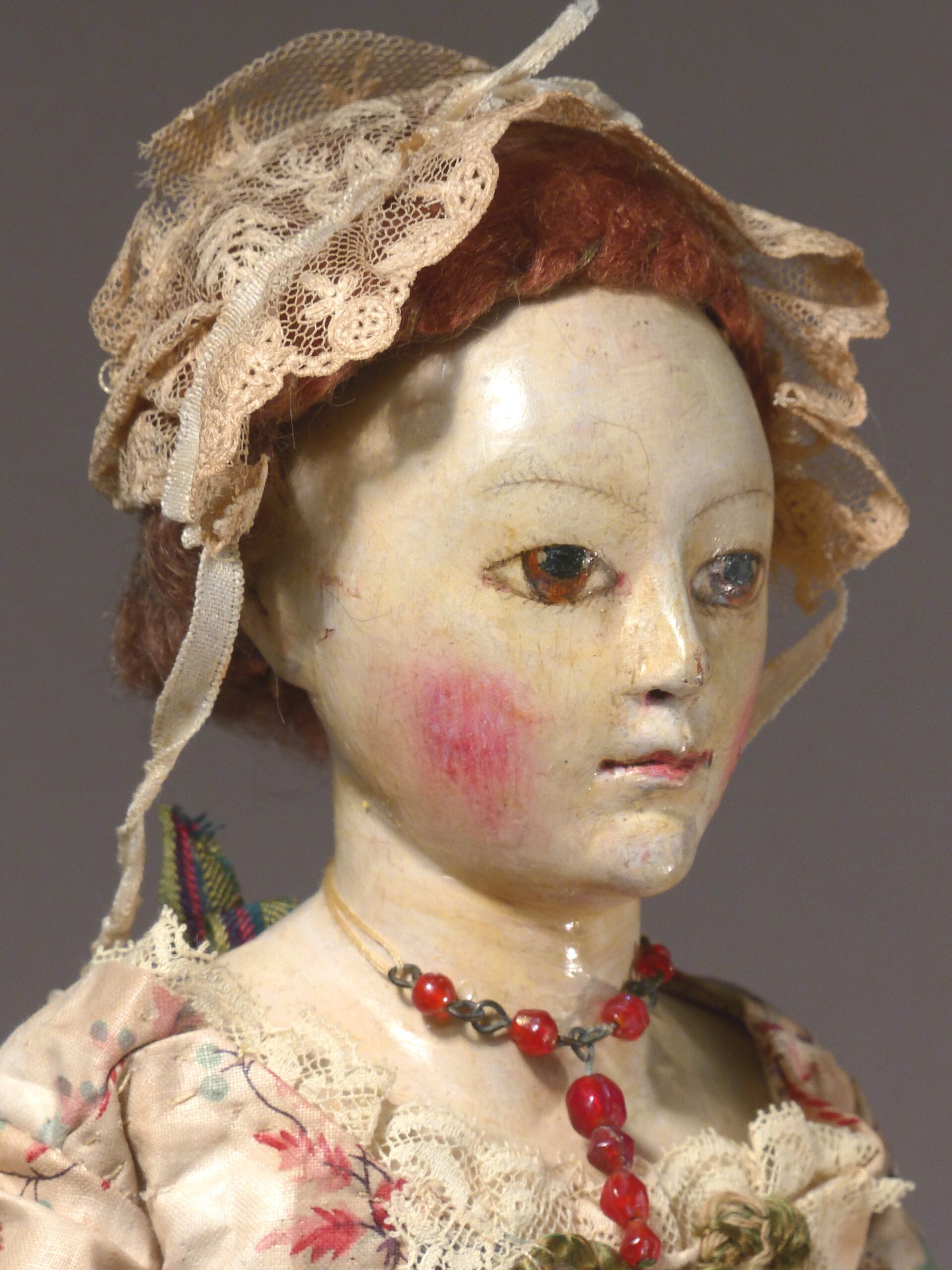
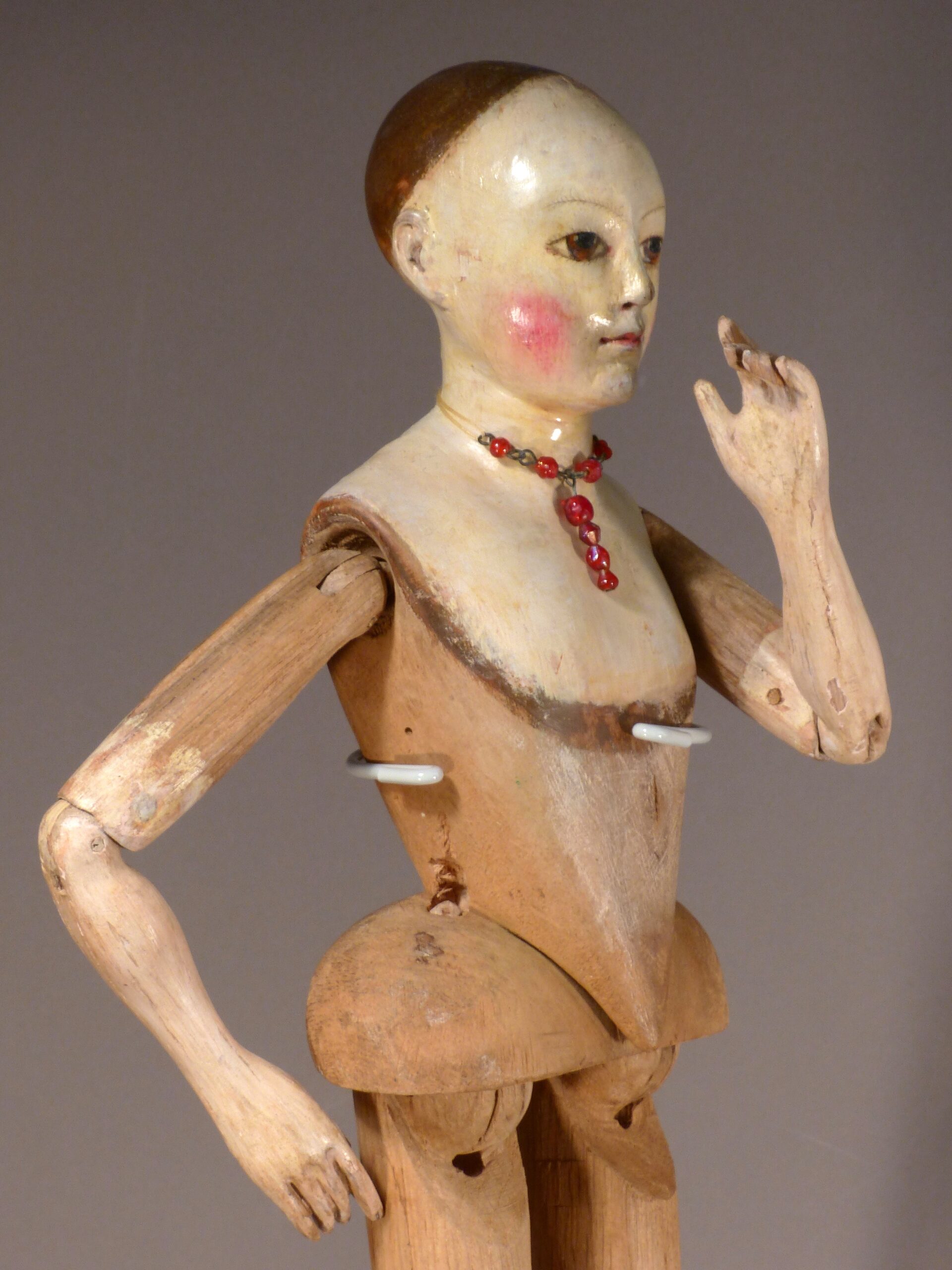
From the pages of a storybook steps this Continental beauty of a wooden doll, who keep supplying artistic and historical satisfaction at every angle. at 16 1/2″ tall, she is an easy size to display, with the only question being whether to display her dressed or not. Starting with the details of her face, her soft brown painted eyes, the refined carving of her nose, her feminine, heart-shaped face with classic profile, her highly defined ears and rouged cheeks over a pale complexion, she begins to tell a romantic tale.
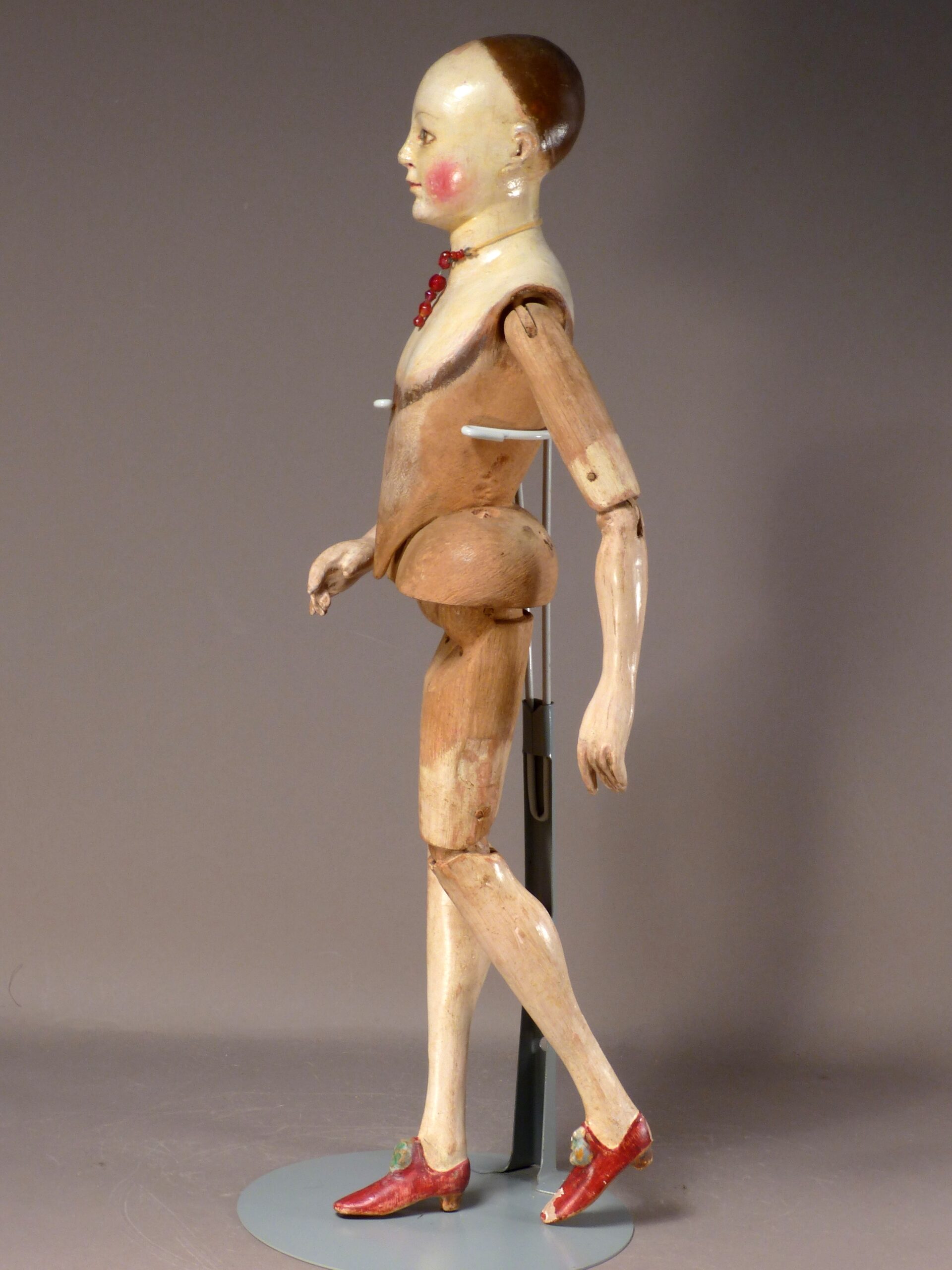
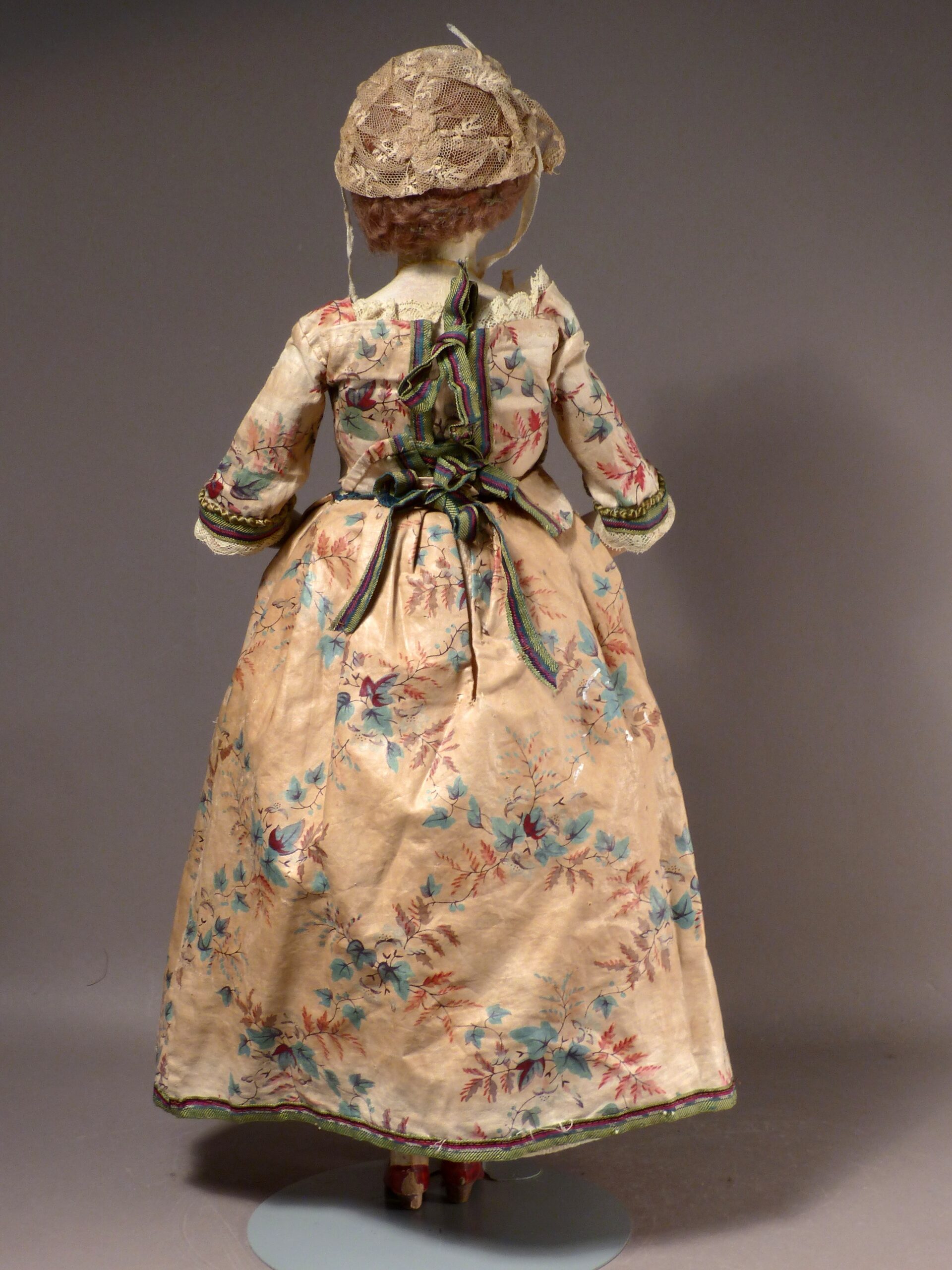
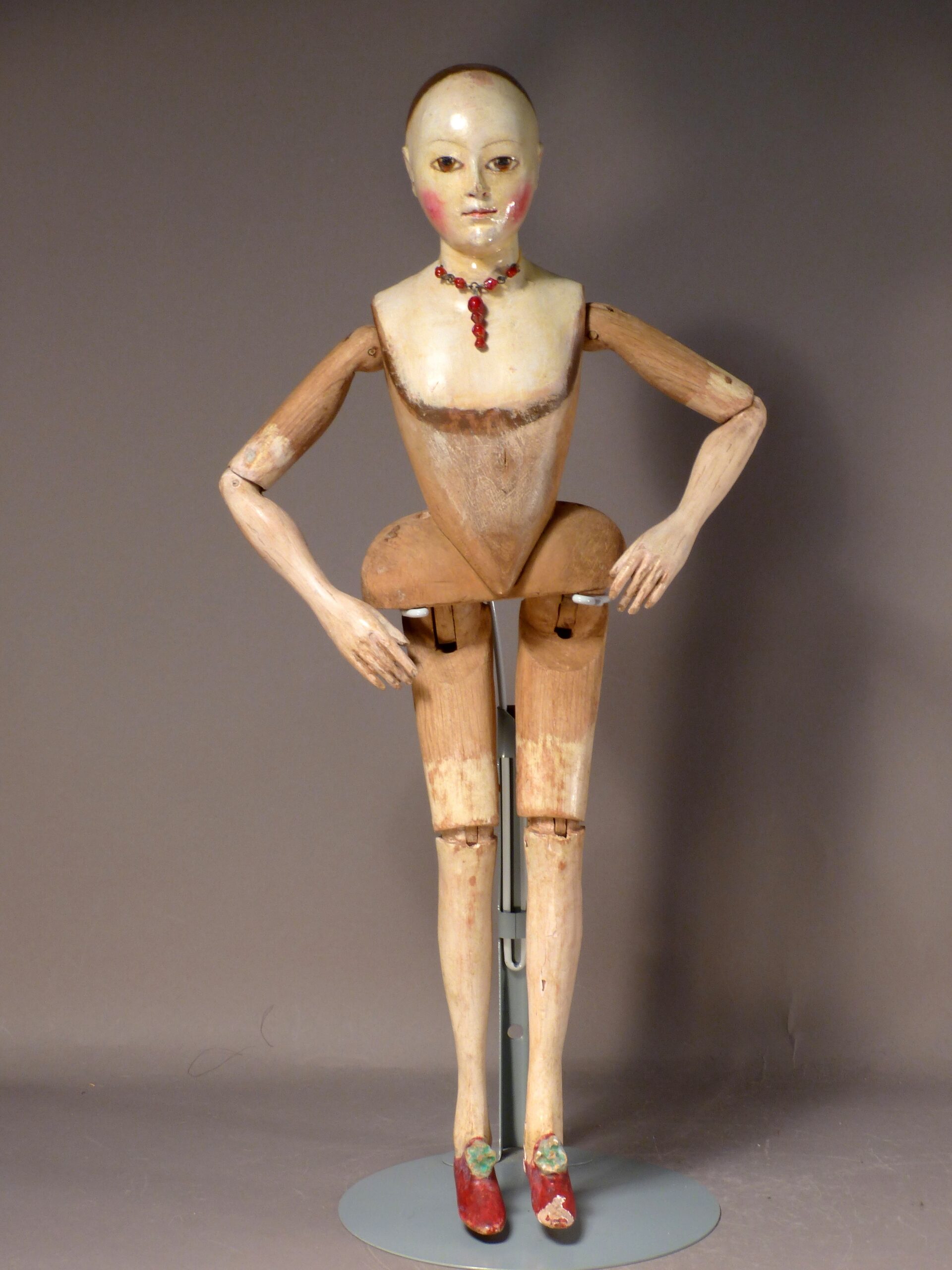
The pale complexion continues below her shoulders and to her slightly molded breast line, where the surface returns to its natural wood finish, with a highly carved-in, slim waist that protrudes in front to simulate the stomacher of an eighteenth century garment.
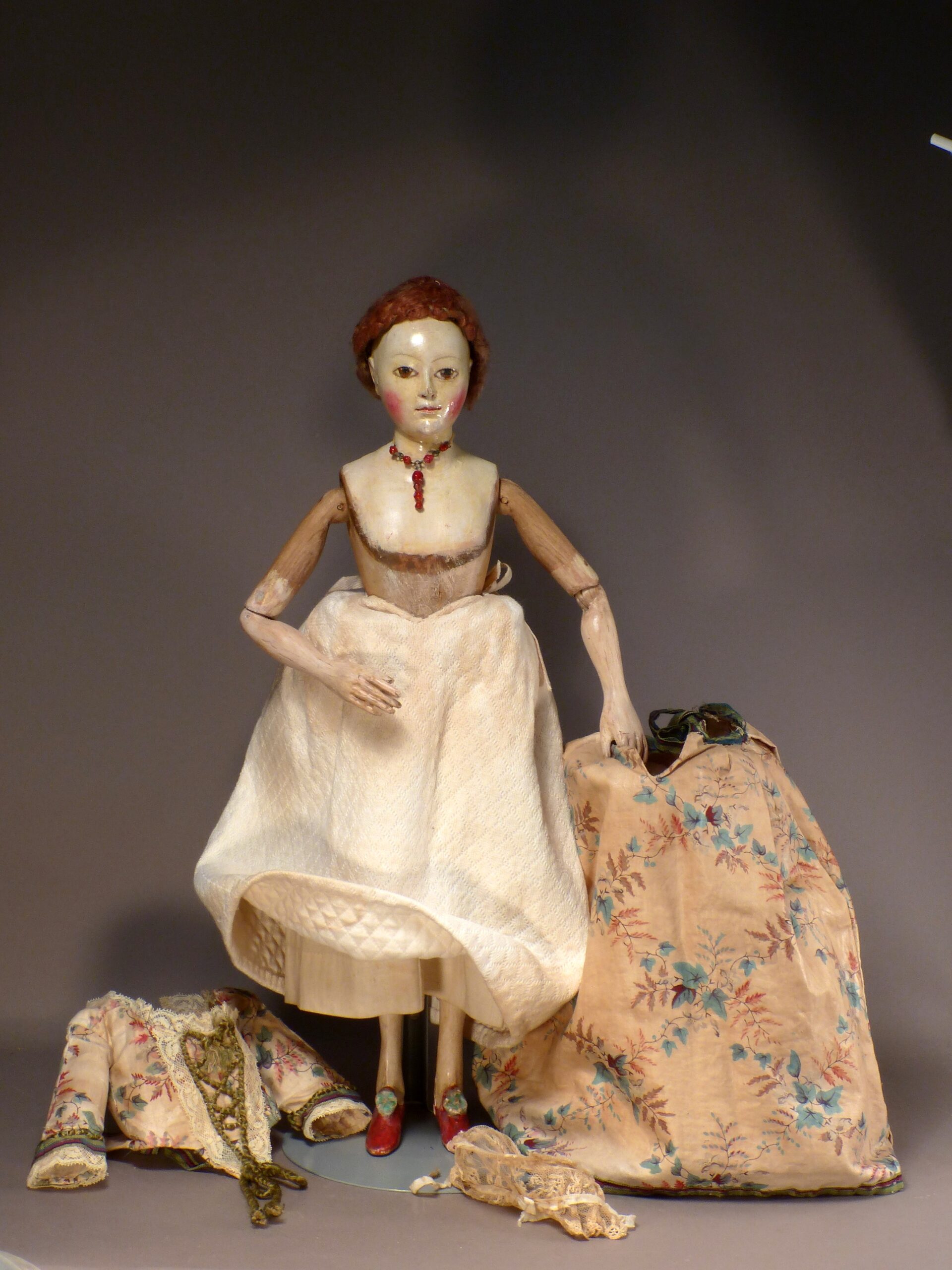
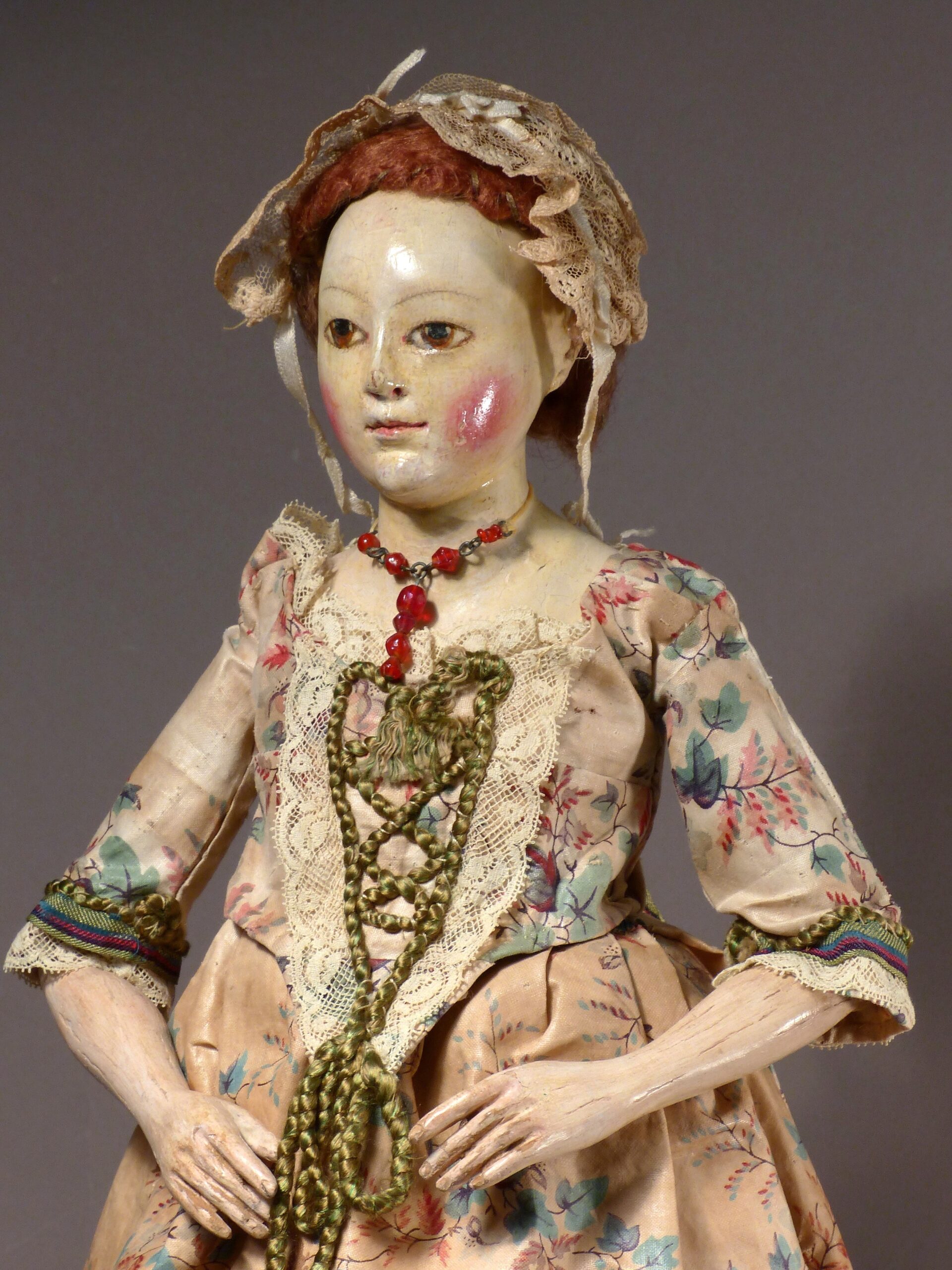
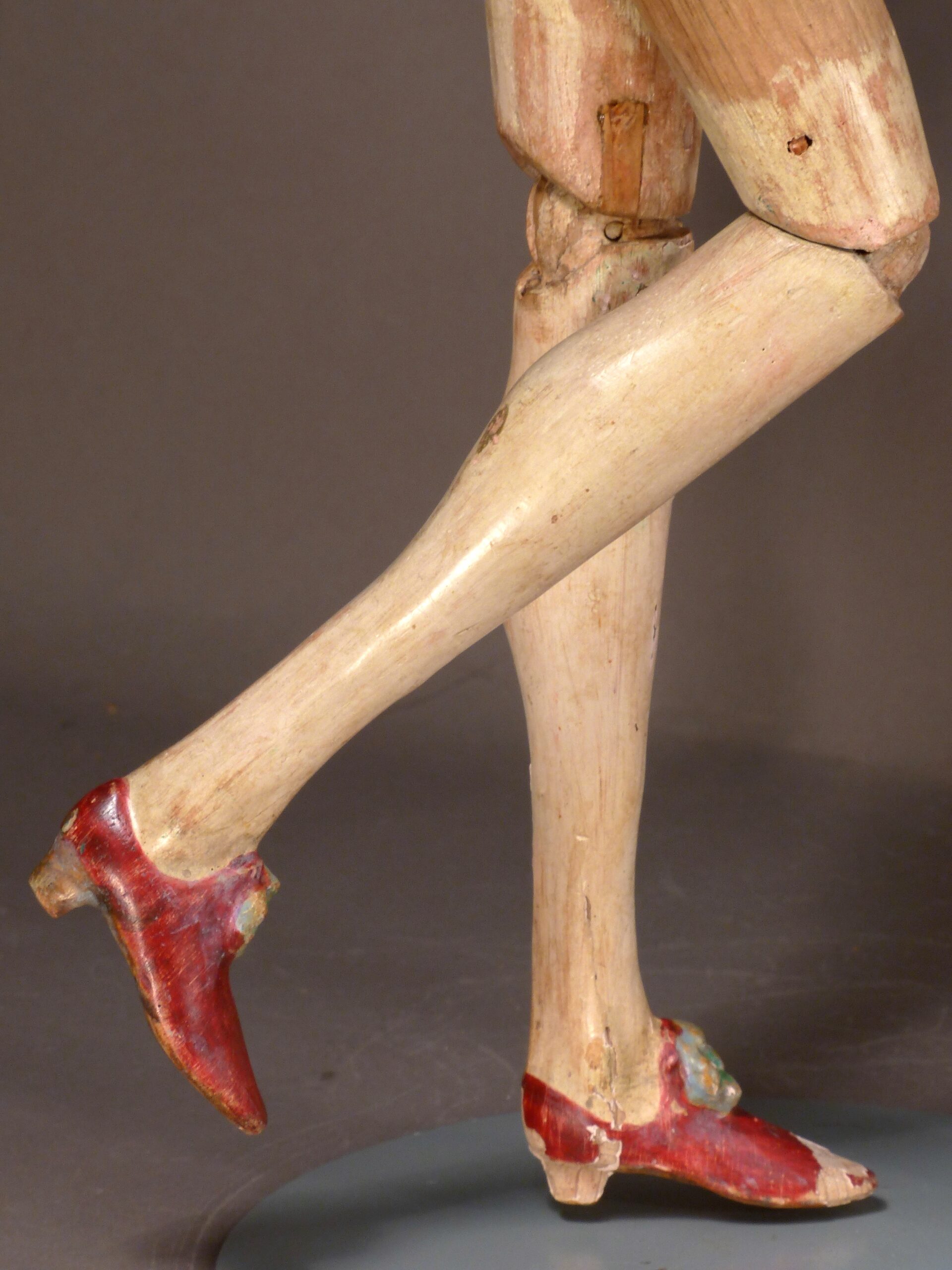
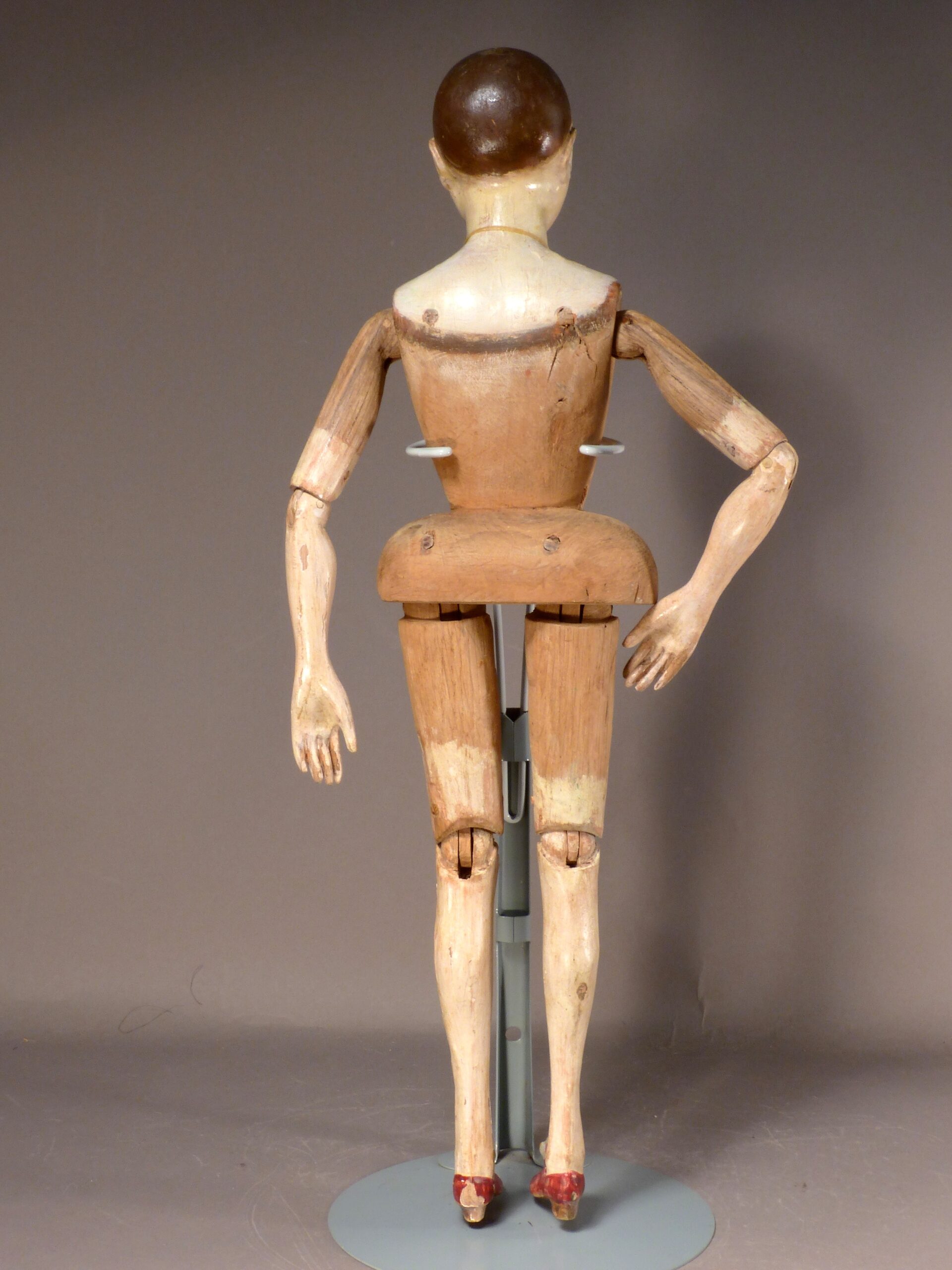
Also typical of this period are the pronounced hips, causing the effect of the pannier that would be worn to fill out the sides of a skirt to the extreme. Again, true to the silhouette of the 1700’s. The meticulously carved wooden limbs are jointed at the shoulders, elbows, hips and knees, with the lower limbs and part of the upper limbs finished in the pale flesh color. Even her feet don’t disappoint, as they are carved dress slippers painted a brick red with a small carved floral detail. Her head is so interesting with its rounded, circular brown painted cap and she truly looks divine not even wearing her soft, reddish mohair wig (which is lined with ancient looking German newspaper) at all. Her face has had some touch up and a layer of protective oil to preserve her condition.
The age of her costume is unknown, however it carries such integrity that goes back in time to a very early period of repeat floral print, cotton chintz fabric and subdued trims, all of which are antique. Of special note are her antique and period correct undergarments, consisting of basic cotton pantaloons and a thick, quilted petticoat whose waistline follows the line of the stomacher, as does the skirt waist of her two piece dress. Her deep red glass choker adds a royal touch.
s s s
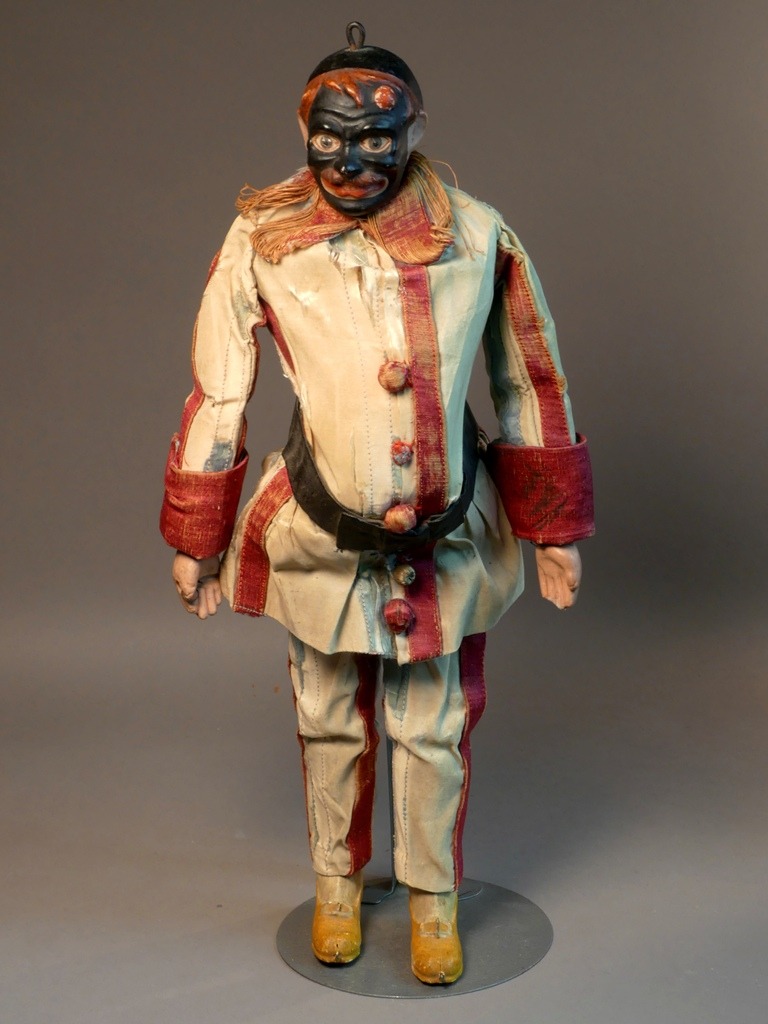
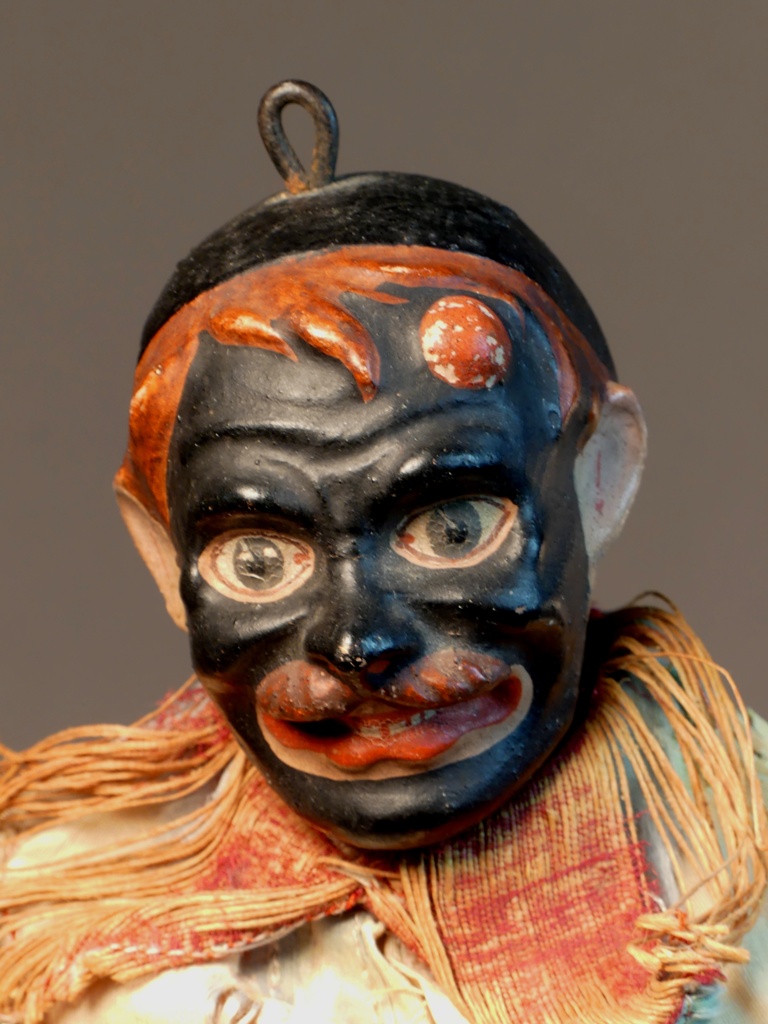
14 3/4" Fine, Early Wooden Puppet
$2,975.
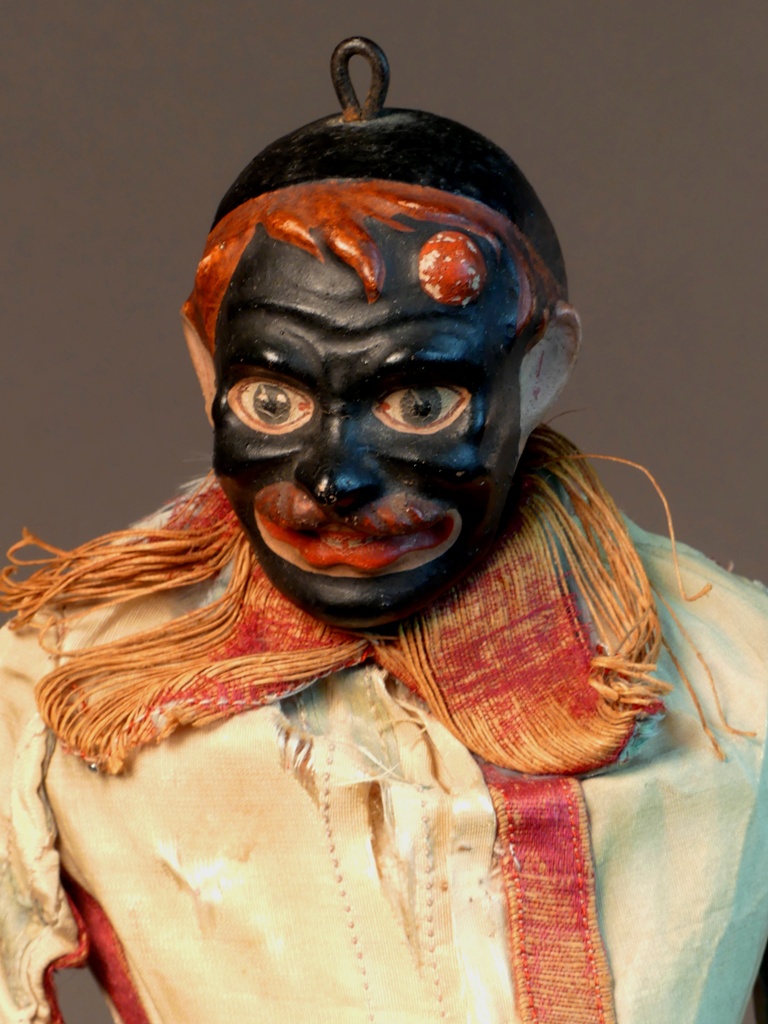
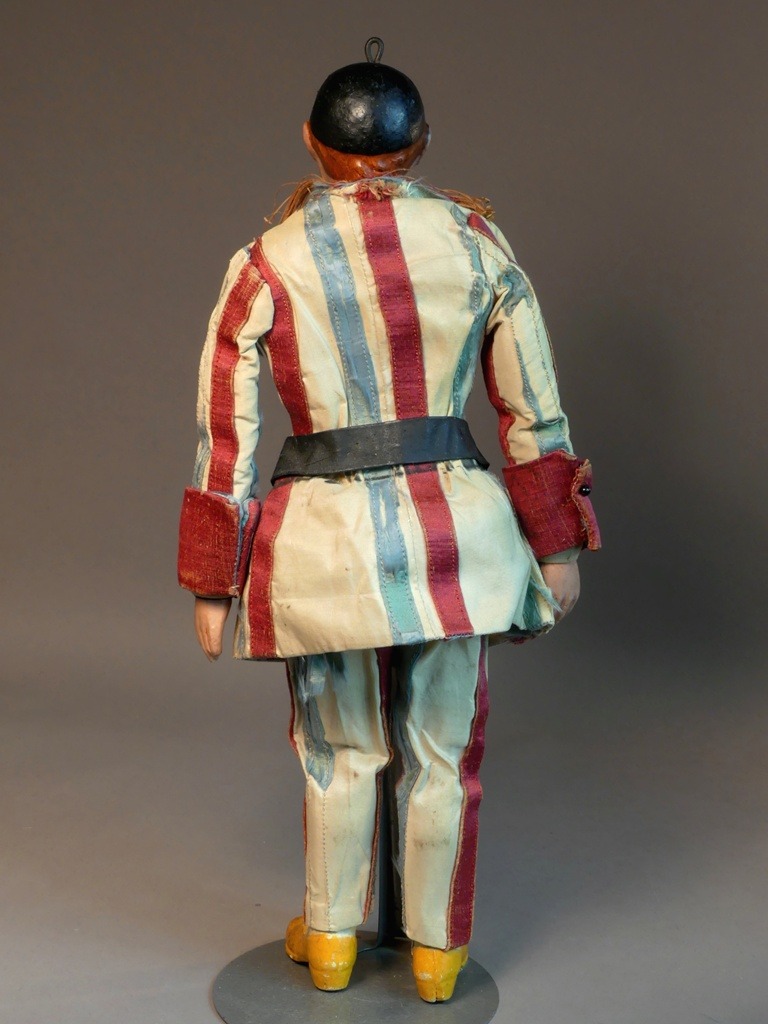
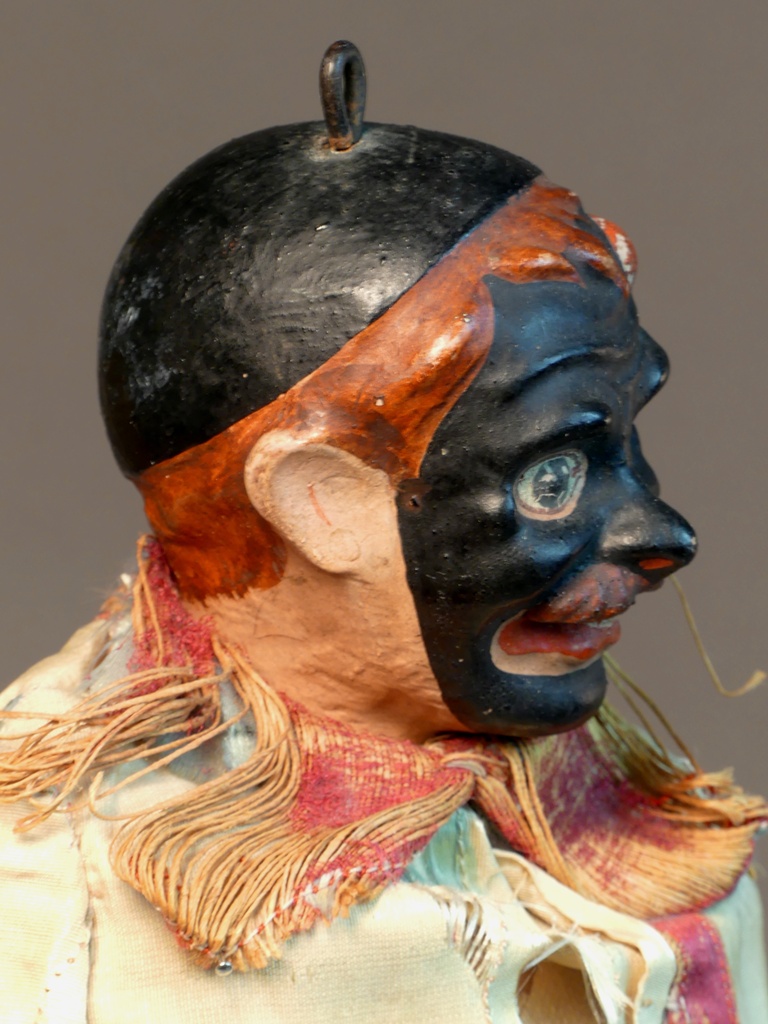
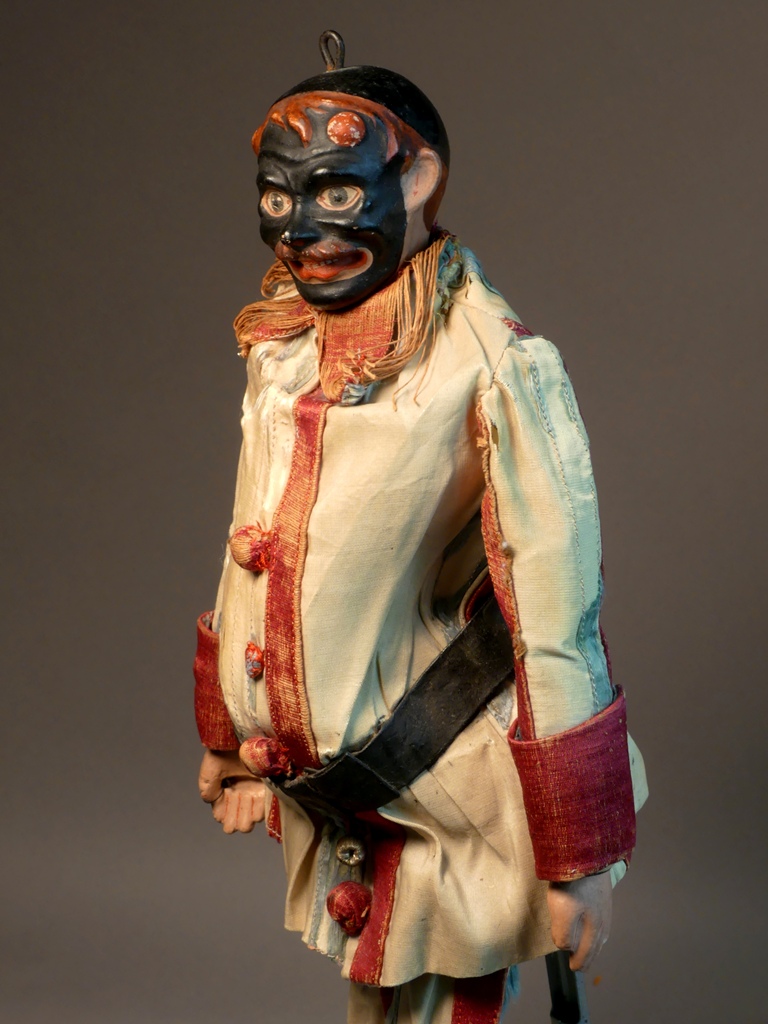
In the world of antique dolls, the character that comes to mind when you think of a clown is the French Polichinelle, who was actually derived from the Neapolitan comedic character Pulcinella of Italy. This clown-like figure was a playful, philosophical, melancholy personality from the Italian comedy theater series, Commedia dell’Arte of the 17th to 18th century. This particular doll or puppet is actually French, with most of it being made of carved wood, the upper arms of cloth, and the metal frame, bloated torso being covered in fabric.
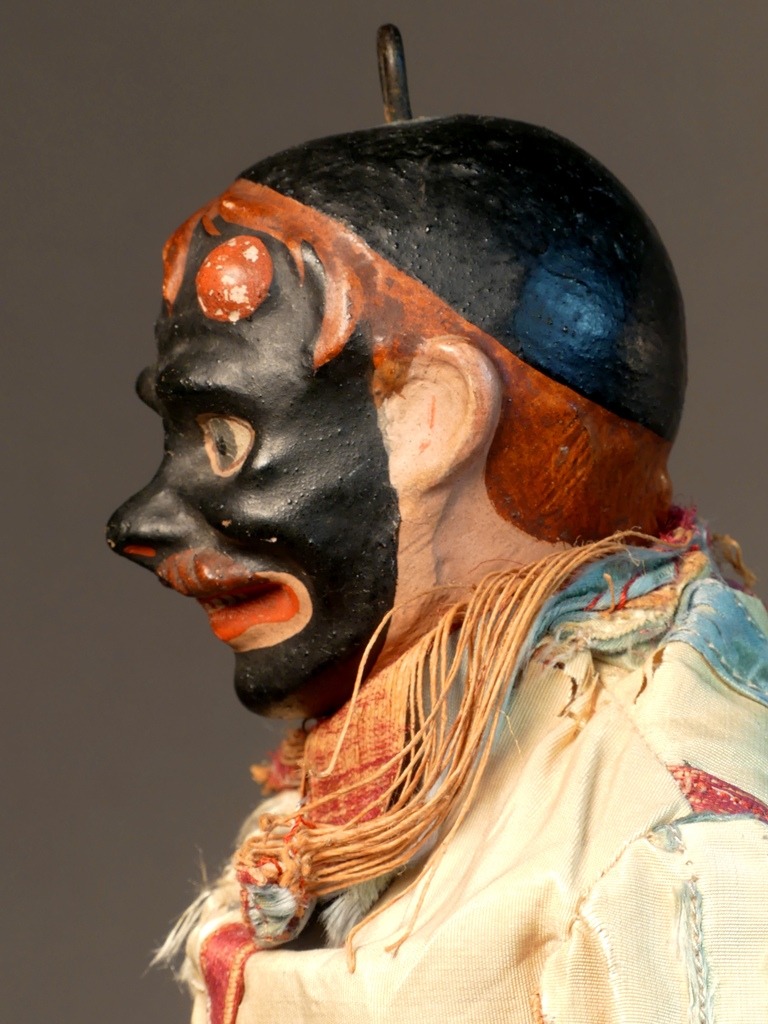
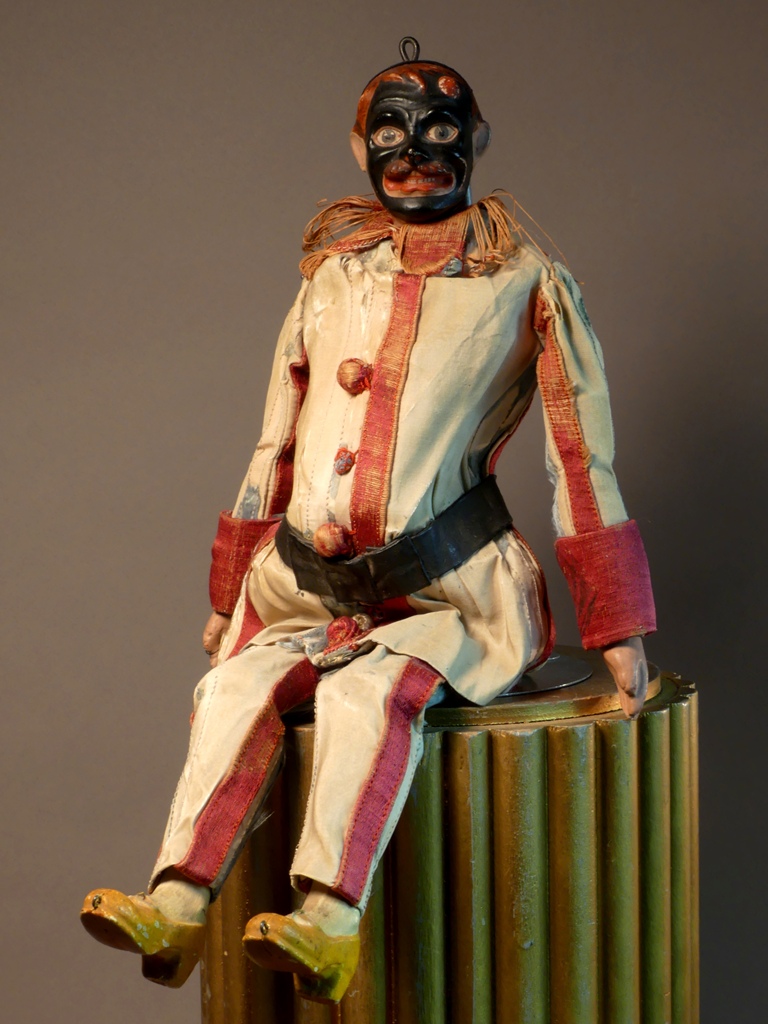
The carving and styling of the head is quite theatrical, with expressive lines and bone structure, a swivel neck, and dramatic and detailed, blue painted eyes that peek out from a black painted mask. The hands are carved wood, and the feet are carved, oversized boots, painted in tones that compliment the costume. That costume of gem-toned silks is the classic look of the theatrical clown character we know as the Polichinelle. It has many areas of wear, but its originality is too important to even think of replacing. There is a hook protruding from the top of his head that accommodated strings for the puppet master’s guiding performance, and the hands and legs were attached as well.
s s s
Grodnertal in Green
13"
Fabulous and Original
$5,200. . ON LAYAWAY
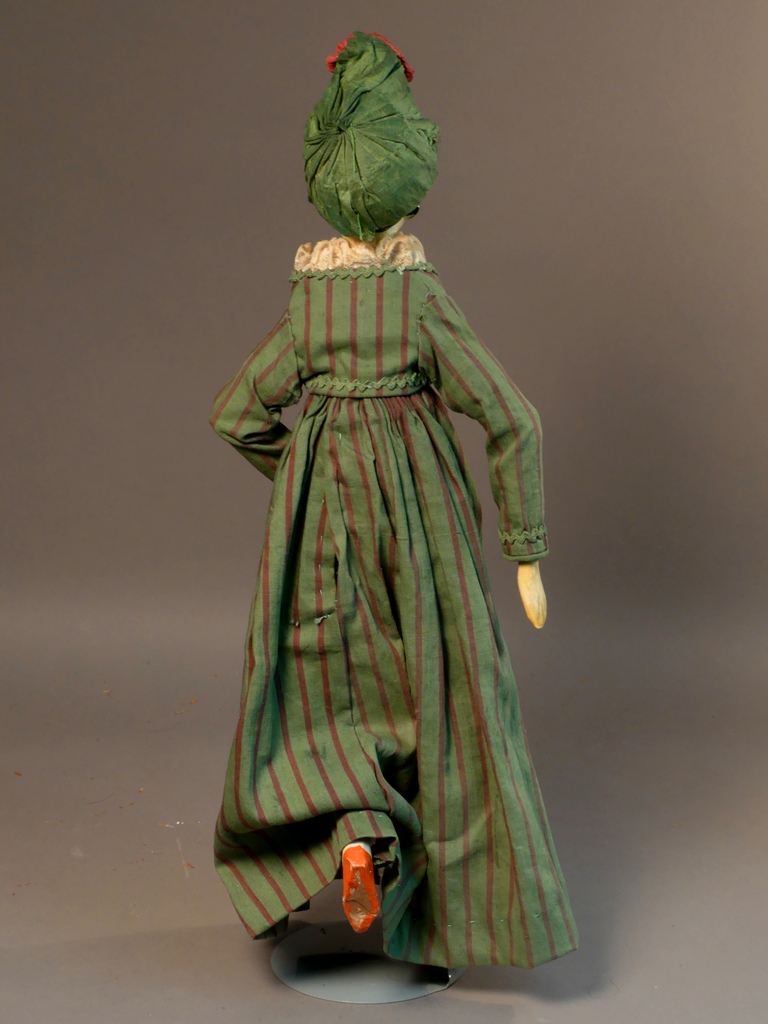
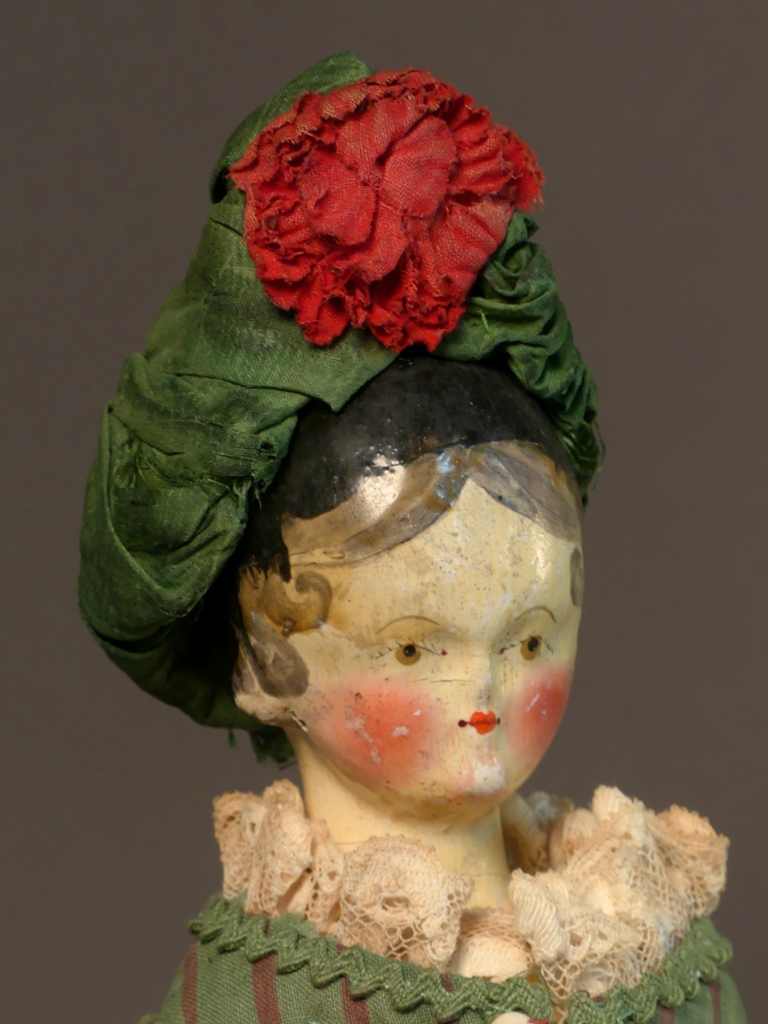
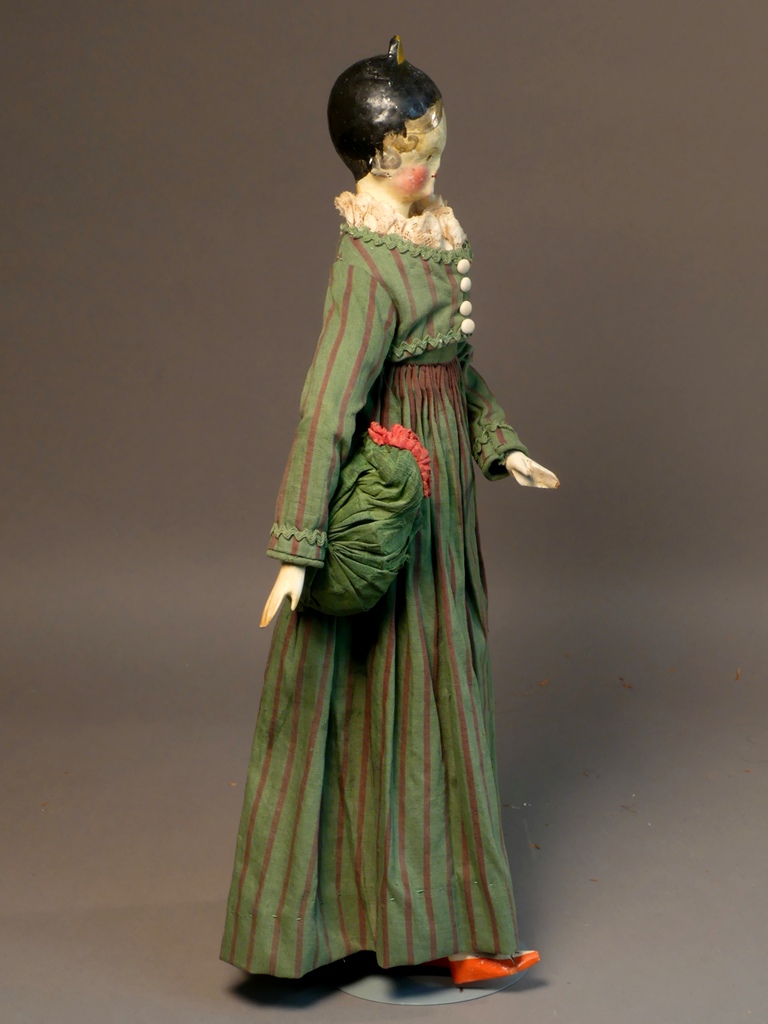
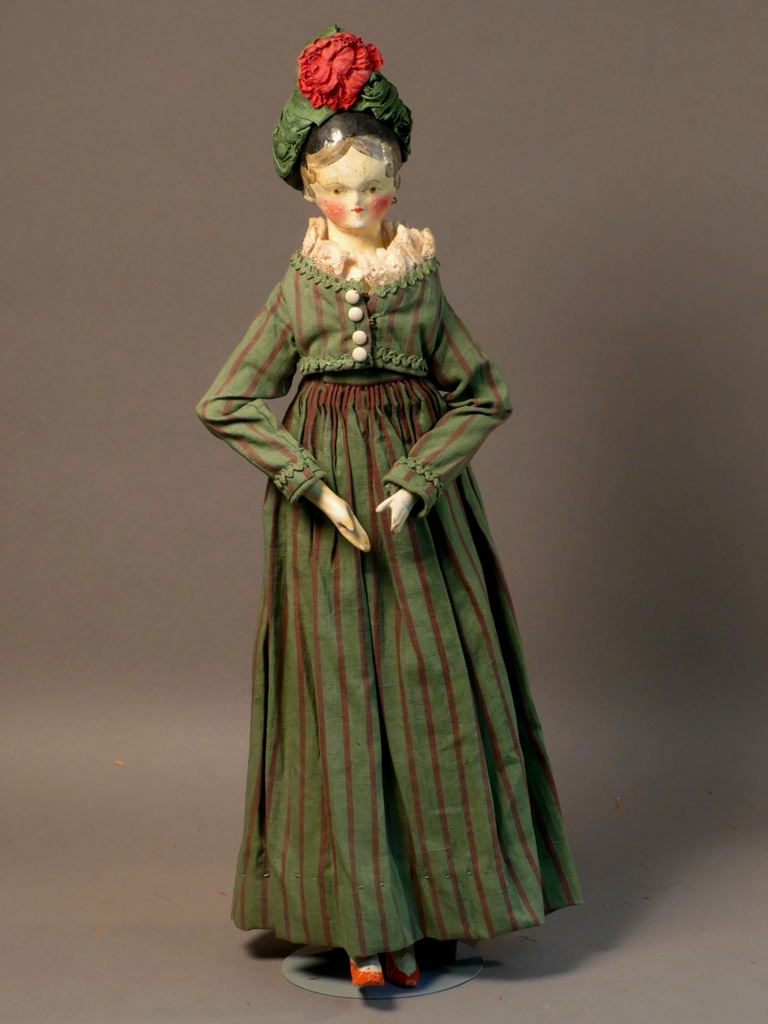
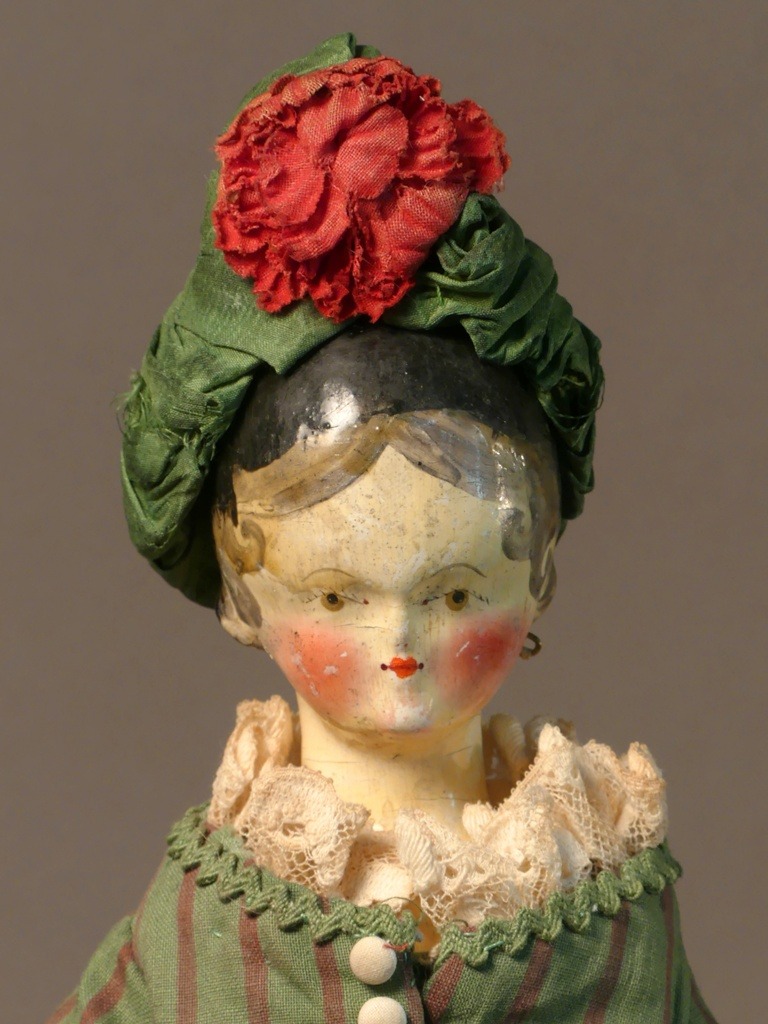
A very serious, early wooden Grodnertal young lady who will nevertheless, bring a smile to your face. She has no idea how complete and fashionable she looks in her original, green and rust striped dress with tightly gathered waistline and matching bolero jacket.
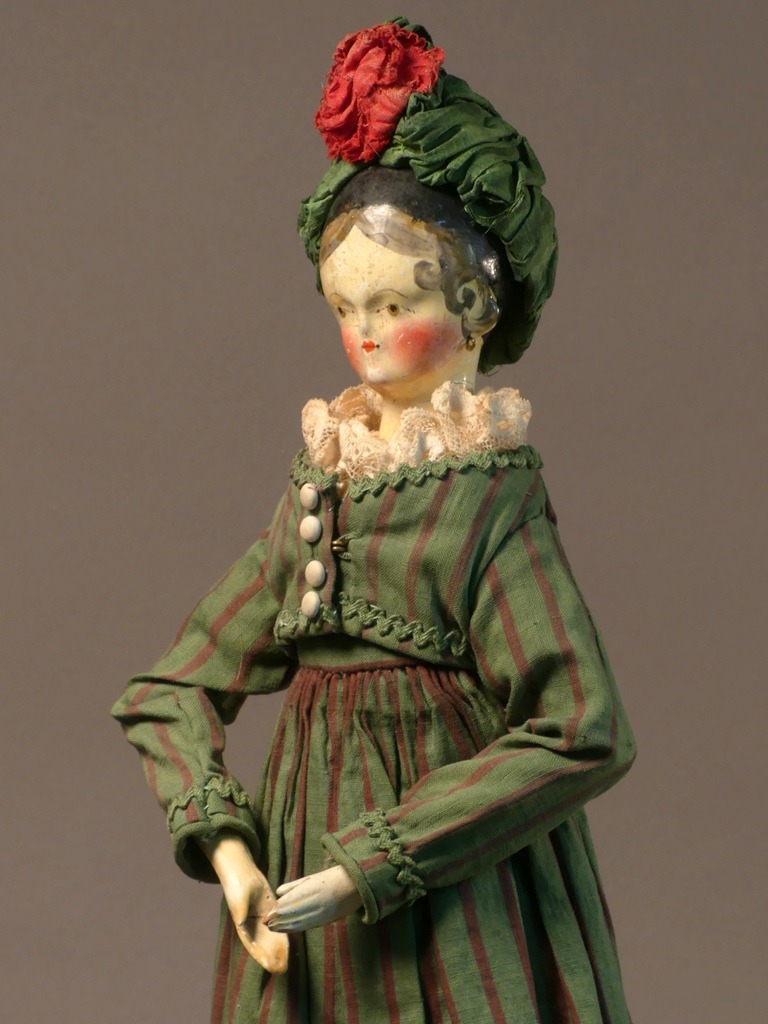
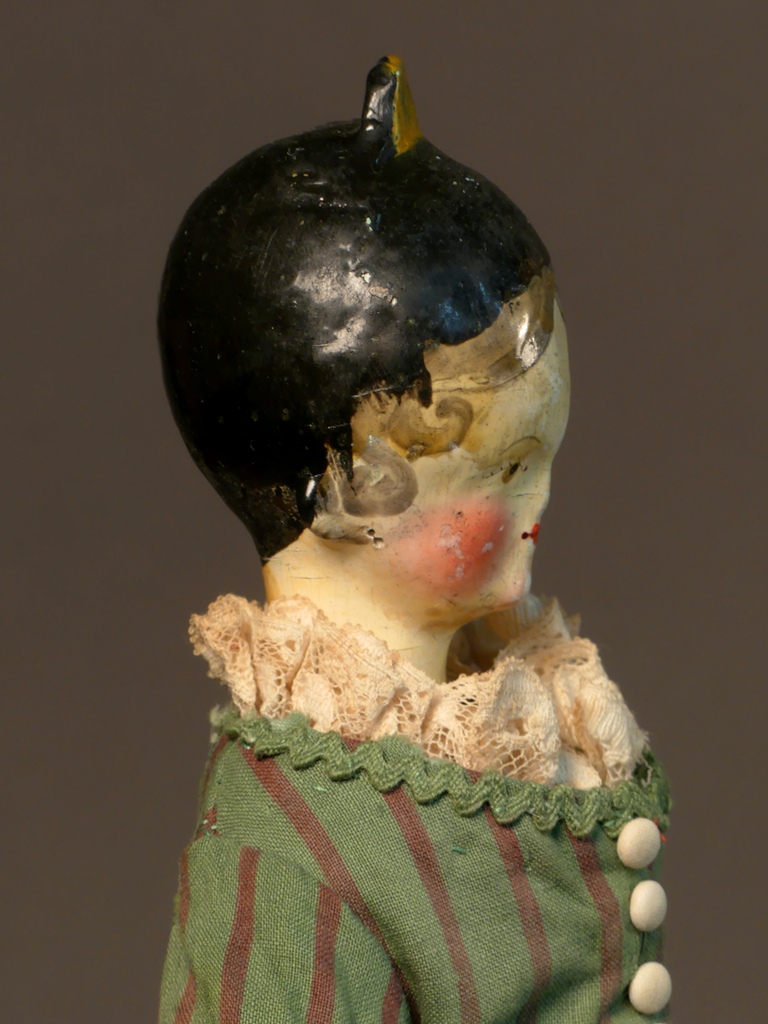
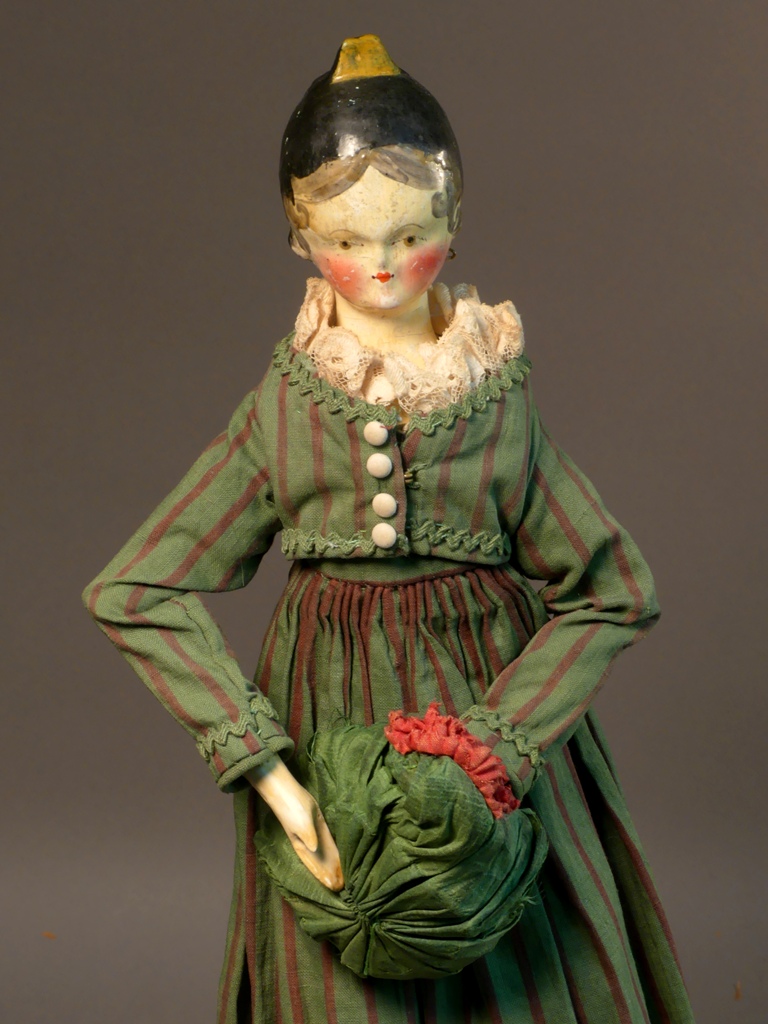
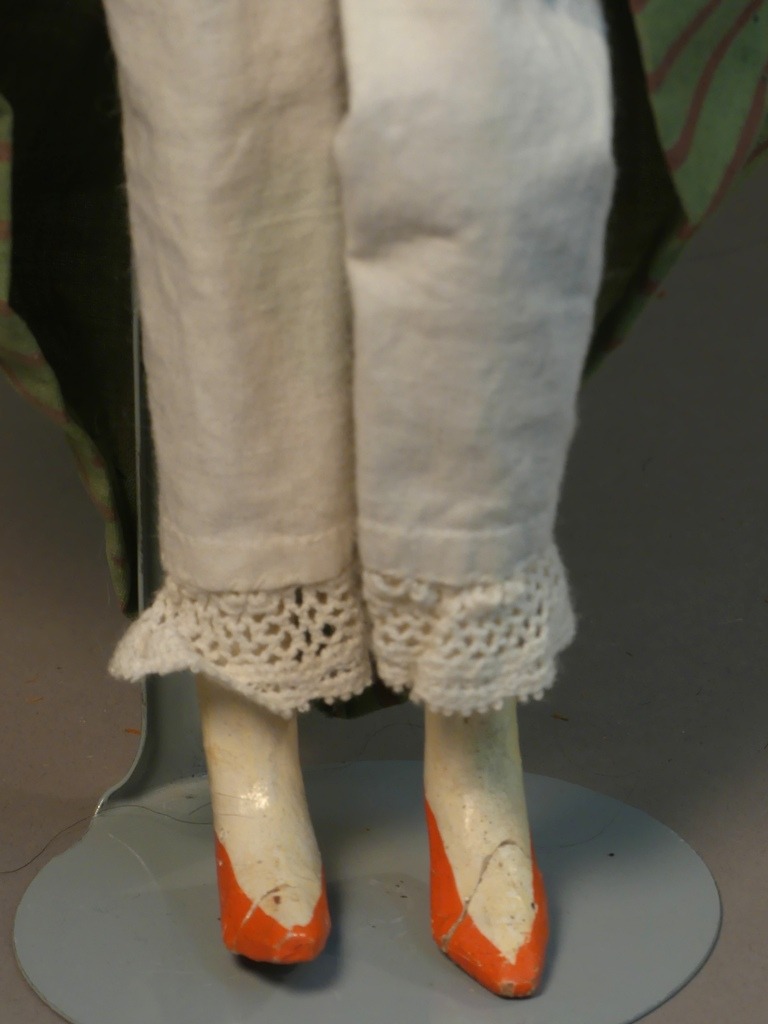
The collar line is heavily accented with gathered lace all around, finished off with four fabric covered buttons in front. But of course, she has a matching hat in the same green, that features a oversized red fabric rosette. Underneath, she wears her narrow-legged pantaloons that follow the sleek silhouette of her ensemble. After admiring her presentation, you can start to marvel at her early, egg-shape carved head with meticulous painting of features, brown painted eyes, crimson little lips, the rosiest cheeks, and a highly detailed hairline of opposing curls that frame her forehead. She also has a carved tuck comb in the traditional golden yellow. Her all wood body is fully jointed, with carved and finished hands that have opposing thumbs, and her pointed, cadmium red, carved slippers peek out from under her hemline.
s s s
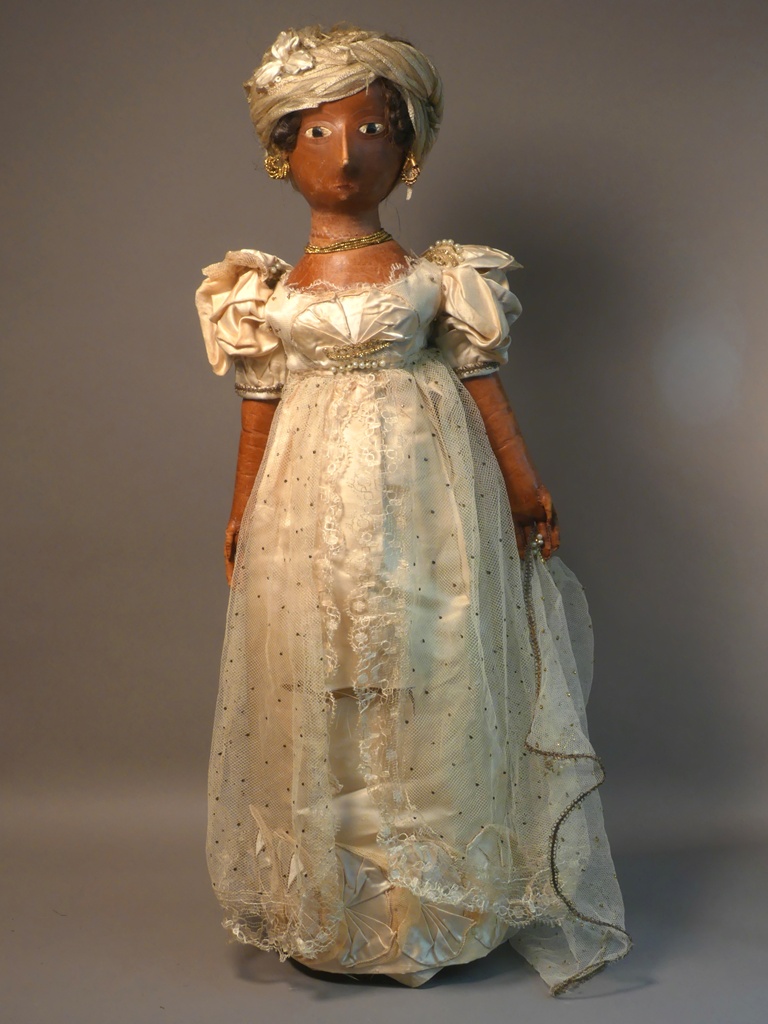
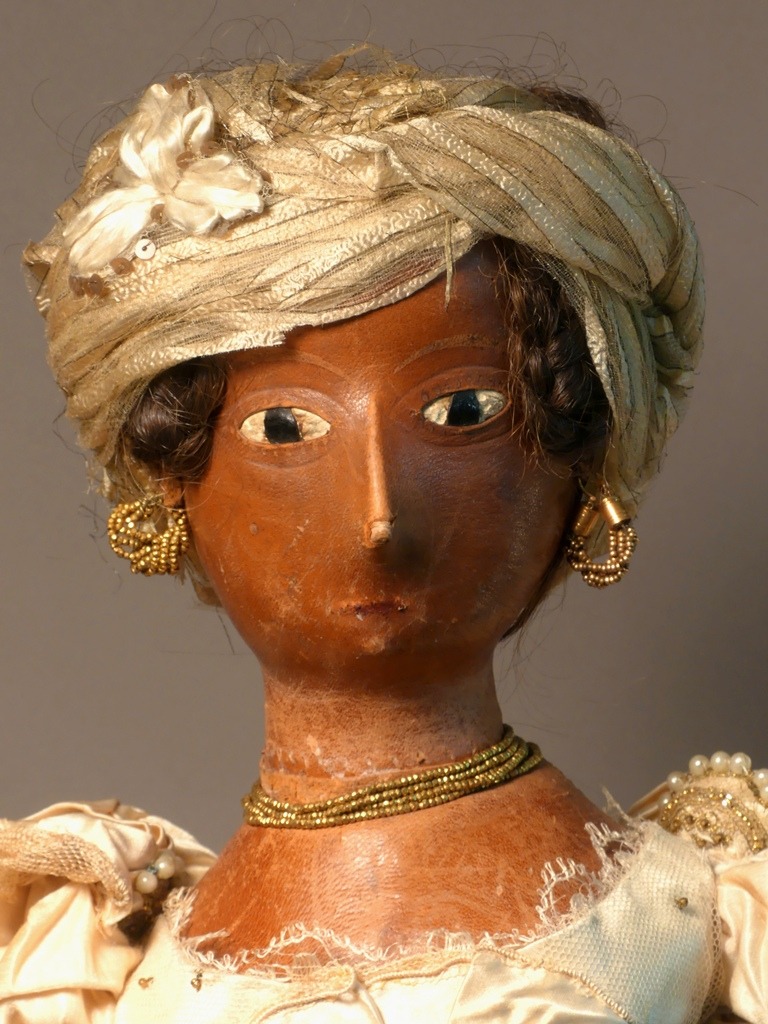
23" Unique Ethnic Lady
$2,450.
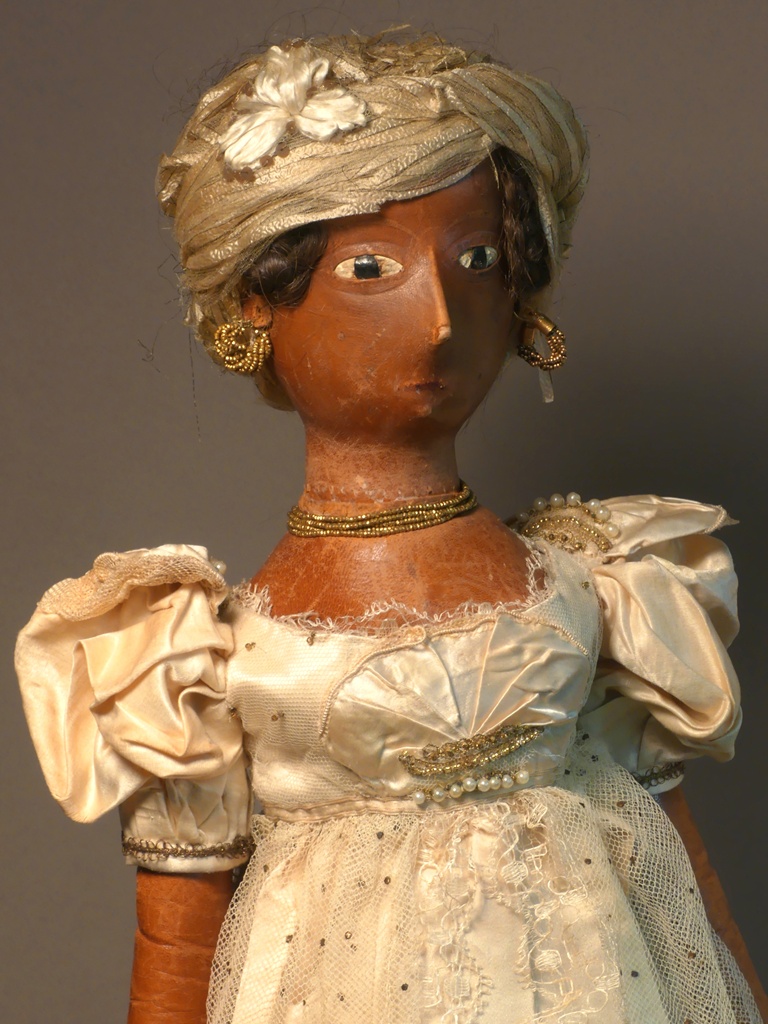
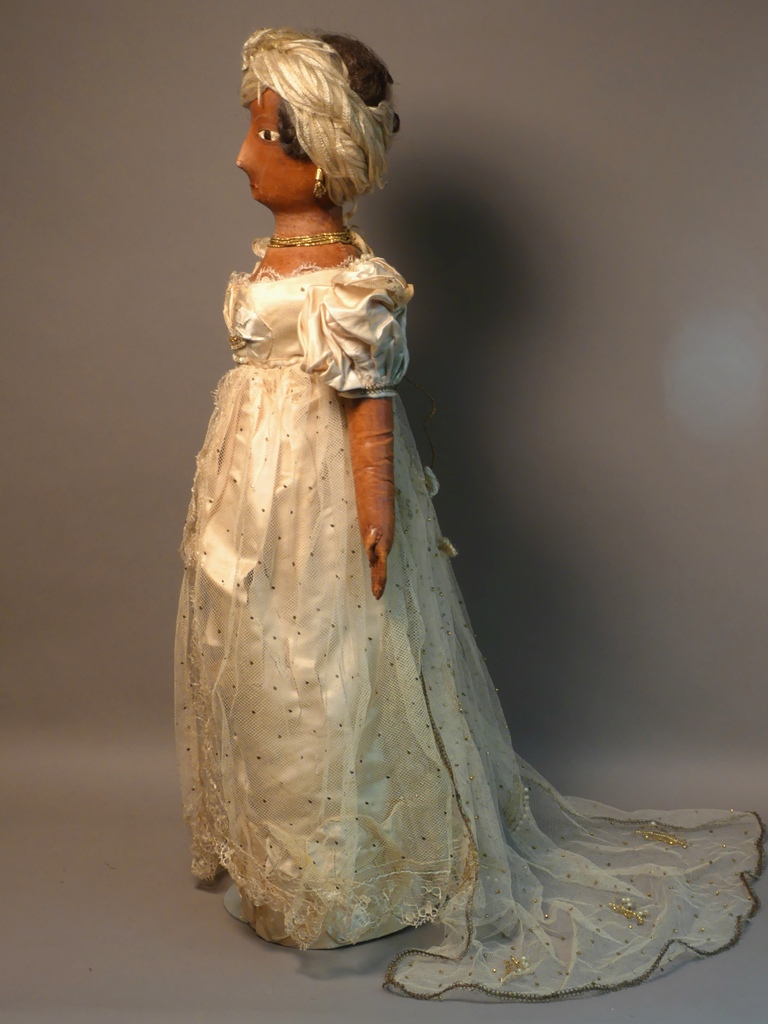
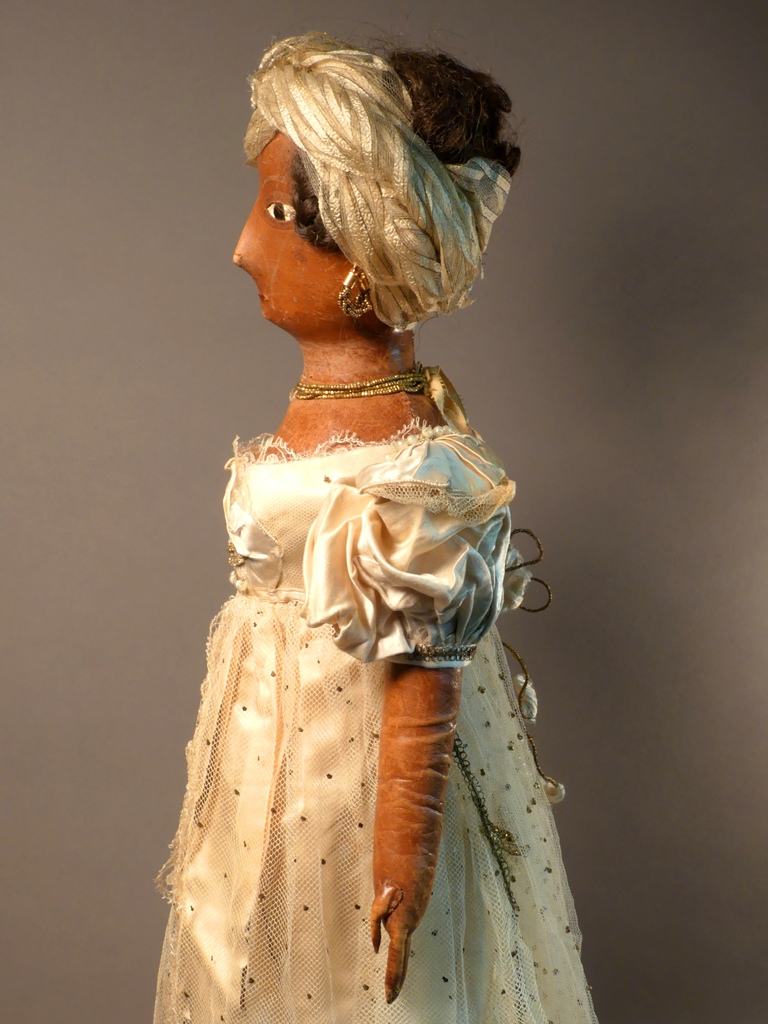
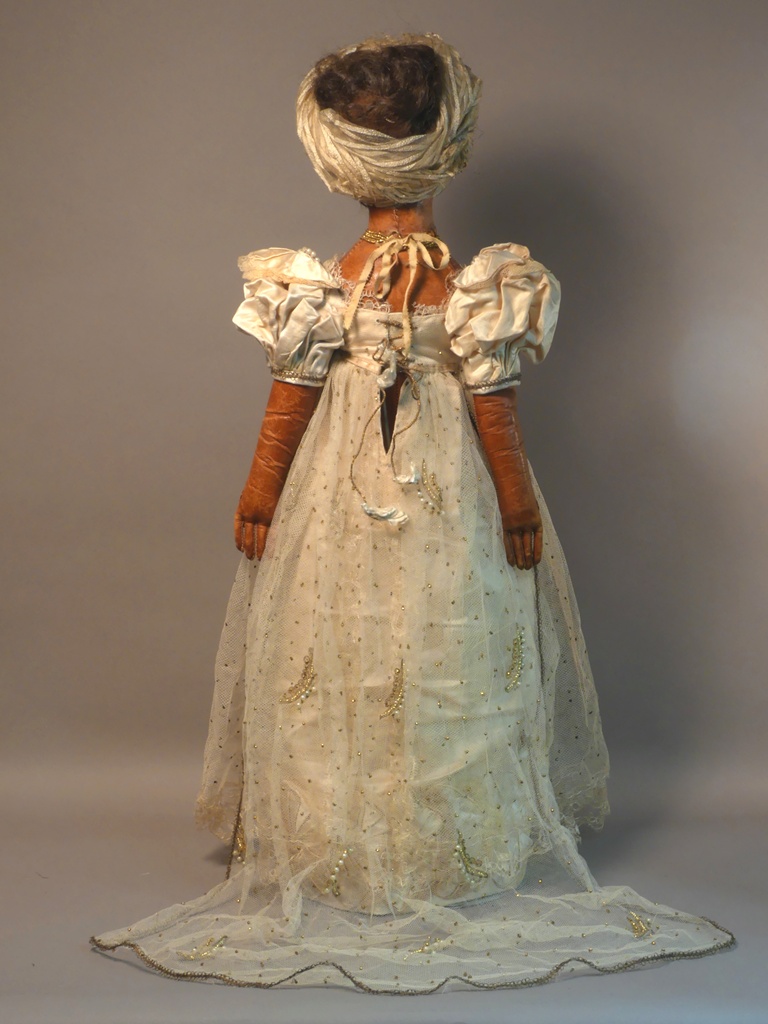
Atop her head is a wrap-around, sheer fabric head dress or turban that matches her 1815 style, long narrow dress with a satin long skirt that is very fragile and splitting in the front, empire waistline, puffed sleeves and an over layer of delicate lace with metallic embellishments floating all around. Truly a rare find!
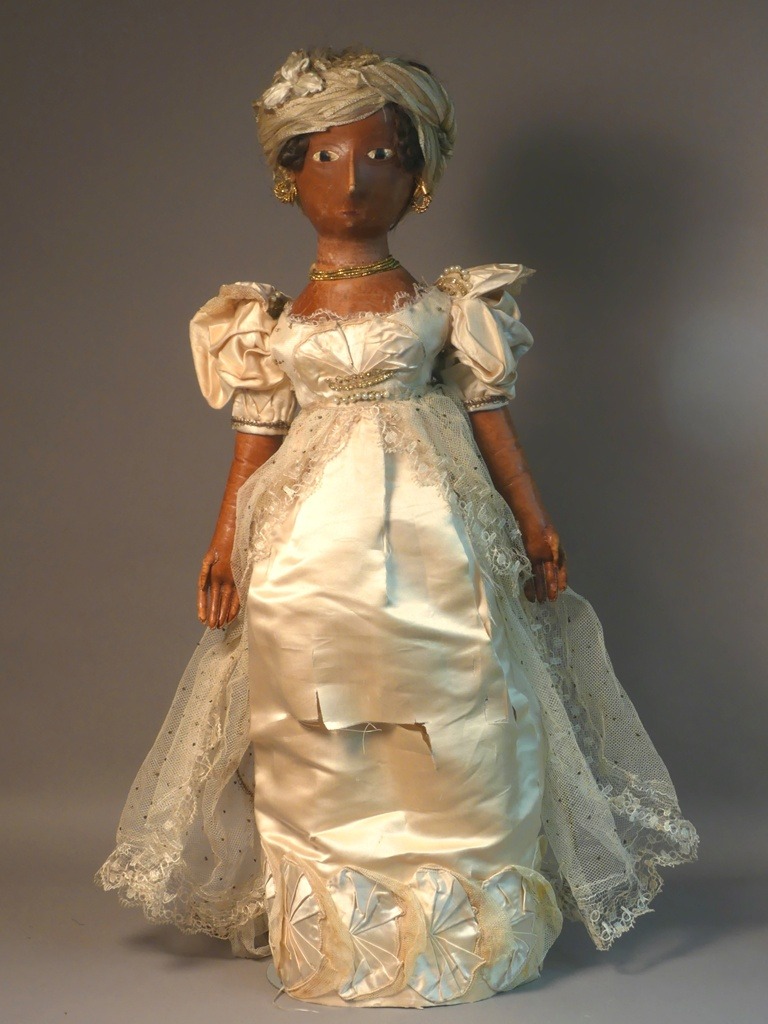
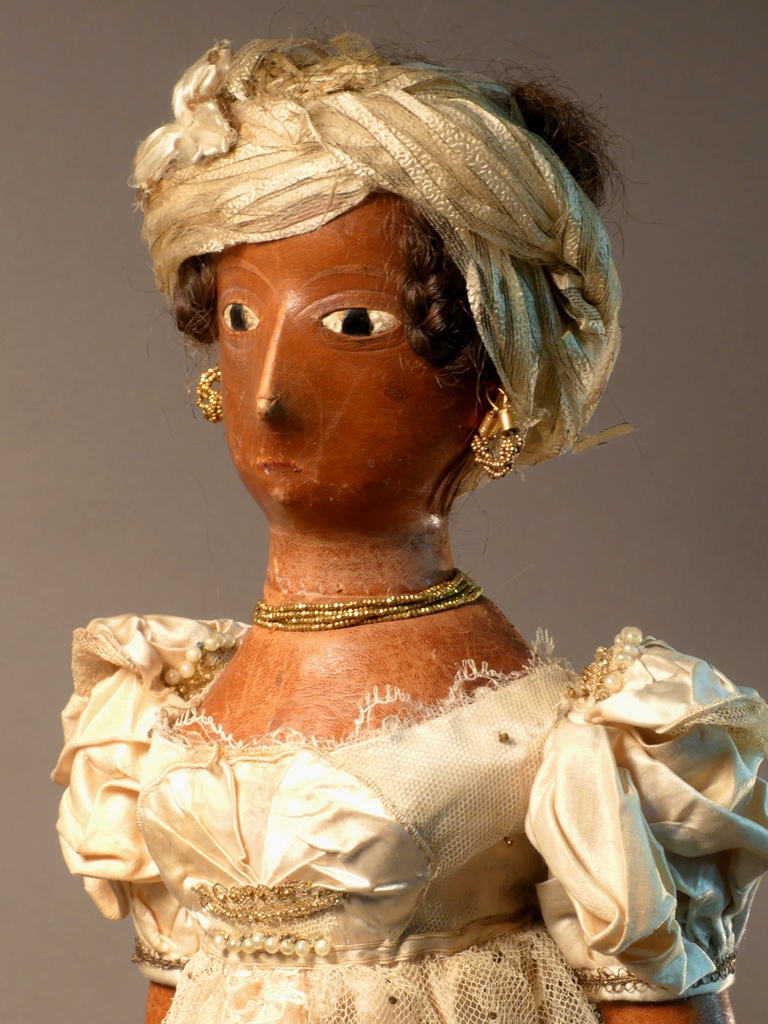
For the collector looking for a new discovery, this may be it, as she has the materials and historical hints we are familiar with, however never in this combination. She is an antique, ethnic lady of the early 19th century, and her all leather body is that of a high quality, French fashion doll, in a warm chocolate brown, with straight jointing and stitched fungers. Her head, however, is also the same leather, but tightly molded over a hard surface like wood or paper mache. She has pupil-less, black eyes of an opaque material, a very prominent, elongated nose, and small, demurely painted, closed lips. Her metallic, beaded earrings peak out from her curly, black human hair. It was discovered that she may represent Empress Josephine, first wife of Napoleon, who is reported to have had Creole heritage.
s s s

Extraordinary Early Wooden Doll
24"

of Oberammergau
$29,750.


Signed Body - 1807


Very seldom in our collecting journey do we get to hold one of these artistic masterpieces in our hands, especially with the doll in such natural condition. From the German city of Oberammergau, where once every decade the tradition of the “Passion Play” takes place, she steps off the page of an art history book and provides us with a three-dimensional study.


She has exquisitely carved facial features and dramatic profile with a pale painted complexion that continues on her shoulders and to the collar line of her chest. Her lower arms and gracefully posed carved hands are of the same color as are her lower legs, with the cadmium red painted, carved slippers at her feet. On the back of her flared, carved hips is the mark of her maker, done in 1807.


The body is fully jointed and is worthy of constant display, however she does have an antique, long-sleeved, fine cotton garment that can serve as a floor-length slip, underneath her chiffon gown and shawl of antique fabrics and trims. Her brunette, tousled human hair wig is soft and romantic, and she wears a subtle string of pearly beads.


s s s

Biedermeier Beauty
16"

as Irish Lass
$1,100.


China dolls from the Biedermeier period of the first half of the 1800’s have adopted that name, and they are know for their bald heads, sometimes with the crown painted black. Over this they wear a styled wig, often of fine human hair, reflecting many of the Apollo knot hairdo’s of the 1830’s and other pulled back varieties of the time. This girl, so wonderfully named “Siobahn”, an old Irish name, by her owner, wears an earthy wool outfit of the British Isles with greens and plaids and multiple layers of warm undergarments to protect her from the chilly weather of the North.


. There is expected wear to parts of her outfit, where fabric has suffered a puncture or some trim has worn through or come loose. Her facial painting is nicely detailed with finely formed lips and red eyelid accents over her deep blue eyes. Her cheeks have a healthy blush and her brunette human hair, original wig is in a pulled back bun of the 1840’s. She has her original cloth body with china forearms and hands, and she wears antique high top leather boots.

s s s

Busy China Girl
16"

+ All Her Cooking Tools
$895


Here stands a circa 1870 china shoulder head girl who has lots of work to do! The biggest clue is that she is personally hauling a multi-piece collection of wooden home and kitchen tools, strapped to her back. Her owner named this industrious girl “Heather”.


Mounted on the original wood frame that is secured around her waist are seven different, useful pieces including three round, wooden and metal sieves, a bucket, some type of grater, a bowl, a spoon, and some coiled, flat wood. She wears her original cotton farm attire that includes a tan colored pinafore with button detail and original cotton undergarments. Her body is of cloth, with arms of carved wood, and lower legs that are carved wood boots painted blue with white button dots.

s s s


Beidermeier China Priest, All Original
$1,950.


Wearing what are his original religious Medieval monk robes, we have a 16″ Beidermeier china man with white china head and shoulder plate, solid dome head with painted black, center-parted hair, and finely painted features. His body is of antique stuffed cloth, looks original, and the arms are of leather with separate fingers. His footwear consists of antique, knitted stockings that act like fabric boots!


His long, white scapular rests front and back, over his black/brown wool tunic, and over that a dark wool long apron with a red, intricately embroidered Crucifix on the chest. He wears a long rope or “cinture” around the waist, along with an antique black rosary.

s s s


Early Peddler Grodnertal Wooden
$4,950


Having first been a part of Austria, then called South Tyrol before World War I, the Grodnertal region near Germany was home to the production of these fascinating wooden dolls. Adding to the warm, inviting charm of these dainty works of art, some were dressed to represent local peddlers of assorted wares, carrying baskets of necessities and delights to be purchased on the street. This particular 12 ½” Grodnertal is an early one, identified by her egg-shaped carved head and the painted hair detail on her forehead. See the extended painted shadows and strokes that represent wisps of hair and curls below. She has painted blue eyes with human detail, prim red upturned lips, and gently rouged cheeks. Her head and torso are one piece, while the limbs are jointed at the shoulders, elbows, hips, and knees.

Her feet are carved as her orange painted little slippers. Look at the impressive costume she wears, which consists of a bold black-and-white striped skirt, a tiny brown print long-sleeved blouse, a white cotton shawl, and long white lace-trimmed pantaloons—kept warm by her bright red hooded wool cape that can rest over her straw, silk-covered bonnet. Now let’s see what she has to sell in her original straw basket of wares… You can spot knitting yarn, scissors on a presentation card, as well as a knife and fork on their card, socks, needles and a needle container, household tools, a dangling glass bottle, a folding pocket knife, a pair of mittens, and some sewing trim on a card—and it goes on, the more you look!

More Early Dolls go to page 2
Mailing Address
119 Muirfield
Williamsburg VA 23188
Phone
(818) 738-4591